

E-tail Intelligence
Begin with an Amazon product or category to understand the shoppers, search behavior and customer experiences surrounding it, then carry that intelligence into AI Twin creation and further research.
What is E-tail Intelligence?
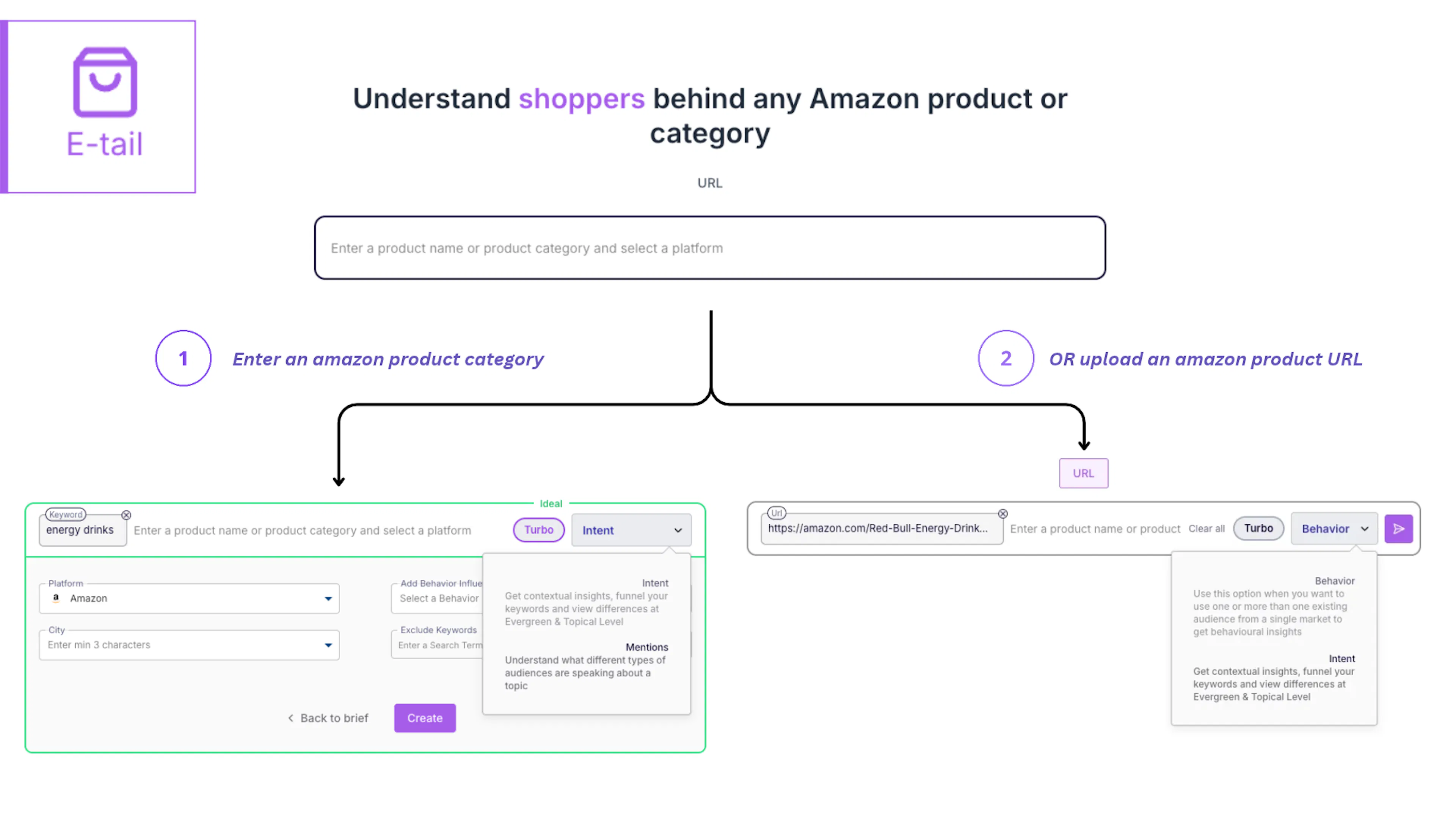
E-tail Intelligence is a product-led research method within consumr.ai. Instead of beginning with a predefined audience, it begins with something present on the digital shelf: an Amazon product URL or a product category.
From that starting point, E-tail can generate Behavior, Intent and Mentions reports. Together, these reports help explain who appears around the product or category, what people are searching for and how customers describe their experiences.
This reverses the usual direction of audience research. In an audience-led study, the researcher first defines a group of people and then examines what they do, seek, or discuss. In E-tail, the researcher begins with the commercial subject and works outward to discover the audience and demand signals surrounding it.
Why begin with the digital shelf?
A product listing contains useful commercial information. It shows what is being sold, how it is presented, its price, customer ratings and reviews. However, the listing alone does not provide a complete understanding of the market around the product.
It cannot independently explain what other categories its shoppers consider, which needs they express through search, how the product fits into their wider lives or which experiences repeatedly shape customer satisfaction and frustration. E-tail treats the Amazon product or category as a research anchor rather than as the complete answer. The product establishes what is being investigated. The resulting reports expand the view from the item on the shelf to the people, intentions, and experiences surrounding it.
This is particularly useful when a team understands the product it wants to investigate but has not yet defined the most relevant audience. The research does not need to begin with an assumed shopper profile. It can use the available evidence to develop a more informed audience hypothesis.
Starting with a product URL or a category
An Amazon product URL and a product category provide different levels of research focus.
A product URL begins with a specific listing. It is appropriate when the research concerns a defined product, brand, pack size or listing experience. The resulting intelligence remains anchored to that item and the signals surrounding it.
A product category begins with a broader commercial space. It is appropriate when the team wants to understand a market beyond one listing, explore adjacent demand or identify the kinds of shoppers and needs associated with a class of products.
The choice changes the scope of the conclusion. A product-level finding should not automatically be generalized to the complete category. A category-level finding may reveal a wider opportunity, but it may not describe the exact consumers or experiences surrounding one particular product.
One product context, three forms of intelligence
A shopper cannot be understood through one type of evidence alone. Behavioral relationships, search activity, and customer reviews reveal different parts of the commercial context.
Behavior Intelligence examines the audience and category relationships surrounding the product. It helps answer who the relevant shoppers may be, what else they appear interested in or looking to buy, and which characteristics distinguish them.
Intent Intelligence examines how demand is expressed through search. It helps answer what people are actively looking for, how search terms differ across the funnel, and which needs, products, or competing brands appear around the subject.
Mentions Intelligence examines how customers describe the product in reviews. It helps answer what customers value, what creates dissatisfaction, and which product or purchase experiences recur across their own language.
How to read the metrics
The E-tail charts use Reach, Uniqueness, and Efficiency to distinguish audience scale from audience relevance.
Reach Score
Reach shows how large the listed audience is compared with the other audiences in that section. A score of 100 represents the largest audience returned.
Reach answers:
How widely does this relationship appear across the product’s shopper audience?
A high Reach score can indicate an opportunity with meaningful breadth. However, size alone does not show whether the relationship is especially characteristic of this product’s shoppers. A large audience may also be common across Amazon more generally.
Uniqueness Score
Uniqueness shows how much more likely the product’s shoppers are to belong to the listed audience than the average Amazon shopper. A score of 100 represents the strongest relationship returned in the section.
Uniqueness answers:
Does this audience reveal something distinctive about the product’s shoppers?
A highly unique audience may help identify a more specific need, identity, or context associated with the product. However, it may still be a small audience. Uniqueness measures the strength of the relationship, not its size.
Efficiency Score
Efficiency combines Reach and Uniqueness. It is high when an audience is both large enough to matter and meaningfully connected to the product’s shoppers.
Efficiency answers:
Which relationships provide the strongest balance of scale and relevance?
The results are ranked by Efficiency because neither Reach nor Uniqueness provides a complete decision on its own. Reach without Uniqueness may identify a large but generic audience. Uniqueness without Reach may identify a meaningful but narrow relationship. Efficiency helps researchers prioritize the audiences that balance both.
The highest Efficiency score is not automatically the correct choice for every research question. A scale-led decision may prioritize Reach, while positioning, innovation, or specialist audience development may place greater value on Uniqueness.
Understanding the E-tail additions to Behavior Intelligence
The standard Consumer Behavior report explains who an audience is across demographics, locations, brands, devices, work, income, traits, education and places visited. E-tail preserves this audience view but adds a product-led question:
What else can the shoppers surrounding this Amazon product tell us about the market, their purchase priorities and the wider contexts in which the product matters?
E-tail answers this through Category Recommendations, People Looking To Buy and Interested In. Each expands the product in a different direction:
- Category Recommendations identifies adjacent product spaces.
- People Looking To Buy identifies other categories connected to purchase-oriented behavior.
- Interested In reveals the activities and subjects that provide wider context for the shopper.
Together, they move the analysis from understanding a single product to understanding the commercial and cultural ecosystem around it.
Category Recommendations
A product’s official category does not necessarily describe the full market in which it competes. Retail taxonomies organize products for navigation, but shoppers organize choices around needs, occasions, and alternatives. A shopper looking for energy, refreshment, or sustained concentration may move between soda, energy drinks, sports drinks, coffee, and other beverages even though those products sit in different retail categories.
Category Recommendations reveals this wider decision space. It identifies the categories most strongly connected to the shoppers surrounding the Amazon product, helping researchers see where the product sits in the shopper’s world rather than only where Amazon places it in the catalog.
This matters because commercial opportunities do not always follow formal category boundaries. A nearby category may represent a substitute, a complementary need, a competing occasion, or an adjacent space in which the same audience is active. The card helps teams identify those relationships before deciding which categories deserve closer research.
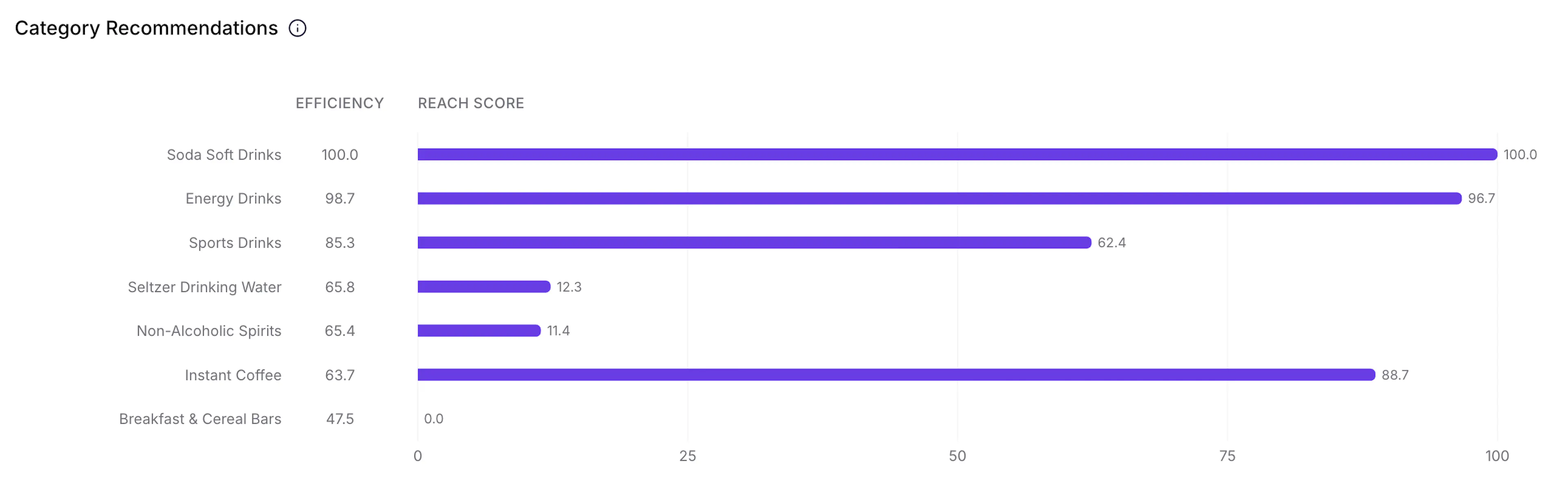
In this example, Soda Soft Drinks ranks first with Efficiency and Reach both at 100. It has the strongest overall relationship and the largest associated audience.
Instant Coffee demonstrates why Reach should not be interpreted alone. It has high Reach at 88.7 but ranks sixth with Efficiency of 63.7. The large difference between its Reach and Efficiency indicates that, although the audience is broad, the relationship is less distinctive to the product’s shoppers than the categories ranked above it.
Breakfast & Cereal Bars ranks last with Efficiency of 47.5 and Reach of 0. Reach of 0 means it is the smallest audience returned in this card, not necessarily that no relevant shoppers exist. Its position indicates that it has the weakest overall balance of audience size and product relevance among the recommended categories.
The recommendations identify category relationships worth investigating; they do not establish sales, market size, or guaranteed demand.
People Looking To Buy
A product can reveal more than its own purchase occasion. The shoppers surrounding it may also be actively considering other kinds of products. This card identifies the categories connected to more purchase-oriented signals.
The purpose of this section is to reveal the shopper’s broader commercial priorities. It helps researchers understand which other needs may be active around the same audience and where useful cross-category relationships may exist.
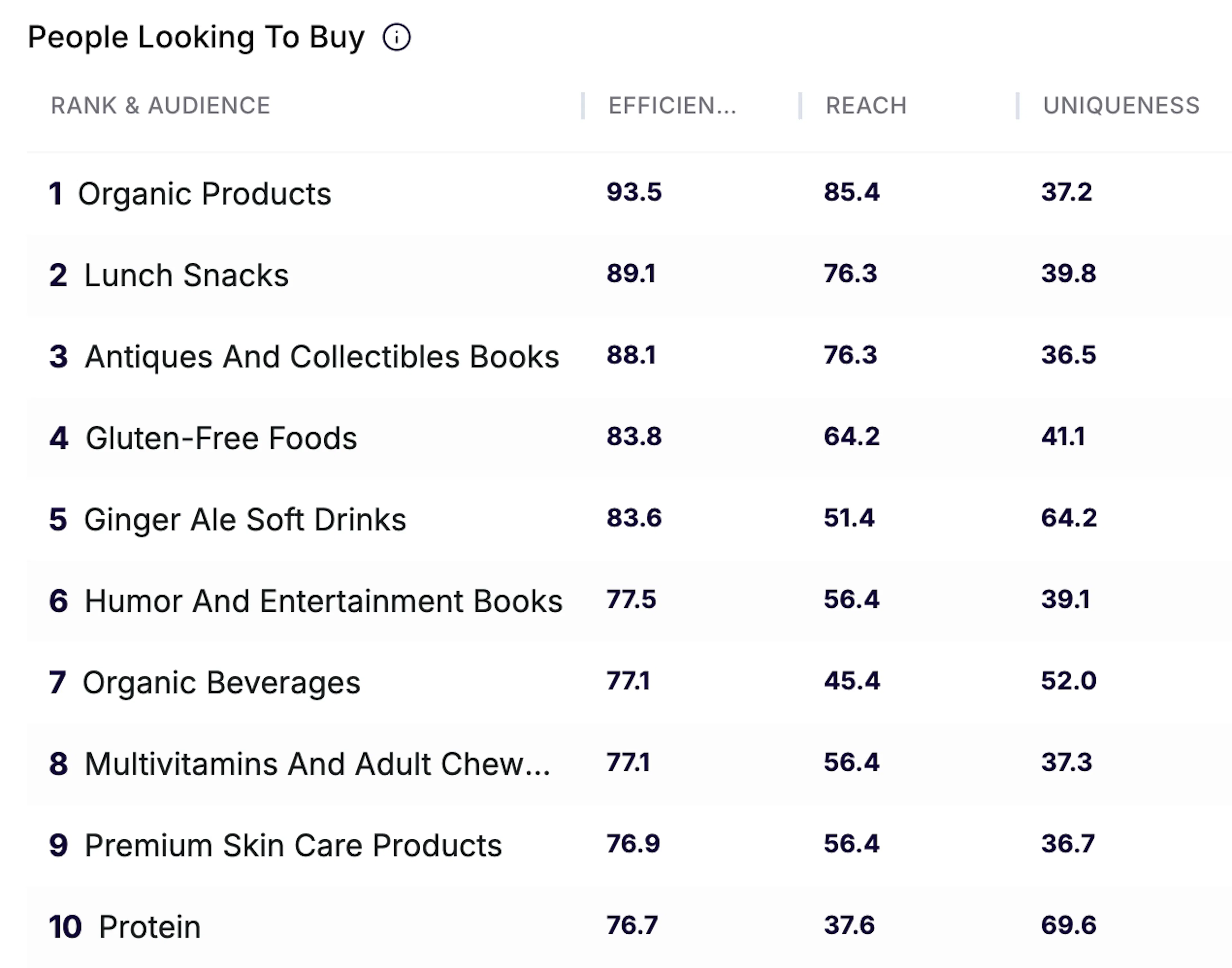
In the example, Organic Products ranks first with Efficiency of 93.5, Reach of 85.4, and Uniqueness of 37.2. Its Uniqueness is moderate, but its large Reach gives it the strongest overall balance. The chart therefore identifies Organic Products as the leading purchase-oriented relationship.
Ginger Ale Soft Drinks ranks fifth with Efficiency of 83.6, Reach of 51.4, and Uniqueness of 64.2. Its higher Uniqueness indicates a strong relationship with the product’s shoppers, but its smaller audience limits its overall Efficiency. The chart therefore places it below the larger and more balanced audiences ranked above it.
The value of People Looking To Buy is not simply cross-selling. The relationships may reveal needs that exist together. Protein, workout supplements, organic beverages, and energy products, for example, may collectively suggest a performance, or wellness-oriented purchase context. That interpretation remains a hypothesis, but it gives the team a more informed direction for subsequent research.
Interested In
A shopper cannot be understood only through the products they appear ready to buy. Their wider interests help explain the routines, identities and cultural environments in which a product becomes relevant.
Interested In shows the topics and activities that surround the product’s shoppers, even when those relationships are not connected to an immediate purchase. Its purpose is to reveal the wider world of the shopper.
For example, if shoppers associated with an energy drink also show relationships with sports, gaming, travel and health and fitness, these should not be read as isolated hobbies. Together, they may suggest contexts involving competition, performance, prolonged concentration, movement or demanding schedules.
The chart does not prove that these interests cause the product purchase. Instead, it identifies possible relevance territories that the team can explore through later research.
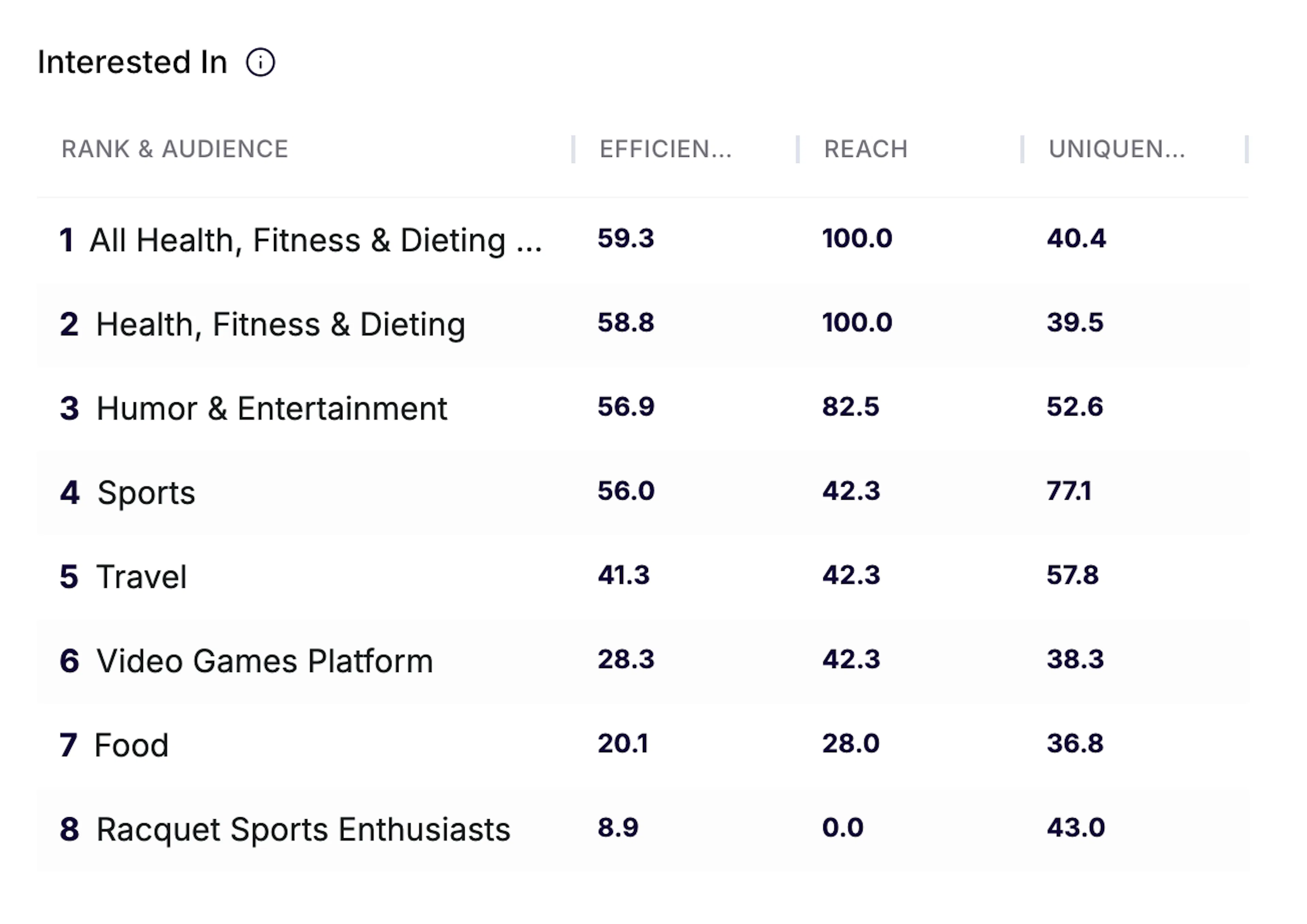
In the above example, All Health, Fitness & Dieting Books ranks first with an Efficiency score of 59.3. Its Reach of 100 makes it one of the largest audiences in the section, while its Uniqueness of 40.4 shows a meaningful, although not highly distinctive, relationship with the product’s shoppers. The combination gives it the strongest overall balance of audience size and product relevance.
Sports ranks fourth with an Efficiency score of 56.0. Its Uniqueness of 77.1 shows that the relationship is highly characteristic of the product’s shoppers, but its lower Reach of 42.3 limits its overall scale. The strong Uniqueness keeps Sports near the top of the table, but it does not outweigh the broader and more efficient relationships ranked above it.
Racquet Sports Enthusiasts ranks seventh with an Efficiency score of 8.9. Although its Uniqueness of 43.0 indicates some relationship with the product’s shoppers, its low Reach means it is the smallest audience returned in this section. The limited scale results in the lowest overall priority within the current comparison.
Interested In can help teams identify potential usage occasions, partnership spaces, creative settings, cultural references, and audience motivations.
Understanding the E-tail additions to Intent Intelligence
The standard Intent report explains how people search around a topic, including the language they use, the stage of the journey those searches represent, and the themes that organize the wider search environment. E-tail preserves this search-intelligence structure but begins with a specific Amazon product or category.
It adds a product-led question:
How do shoppers search around this Amazon product, and what does that search behavior reveal beyond the language used on the listing?
The Amazon input becomes the anchor for the Category, Core Keyword, Top Search Terms, Conversion Funnel, Categories, Top Themes and Keyword Table. Together, these sections connect the product on the digital shelf with the wider search journey surrounding it.
From the Amazon listing to the search environment
An Amazon listing shows how the seller describes the product. Search behavior shows how shoppers describe the need for themselves. These two forms of language may overlap, but they are not always the same.
A brand may organize a listing around its product name, while shoppers search by category, function, pack size, ingredient, problem, competitor, or purchase occasion. E-tail Intent helps reveal whether the product is being found and considered within the same frame in which it is being presented. This matters because the product page is usually a destination, not the beginning of the decision. Before reaching it, shoppers may explore the category, compare alternatives or become more specific about what they want. E-tail Intent reconstructs that surrounding search context.
Summary
The E-tail Intent report opens with the Amazon product image and a summary containing the Category, Core Keyword, and Top Search Terms derived from the product input.
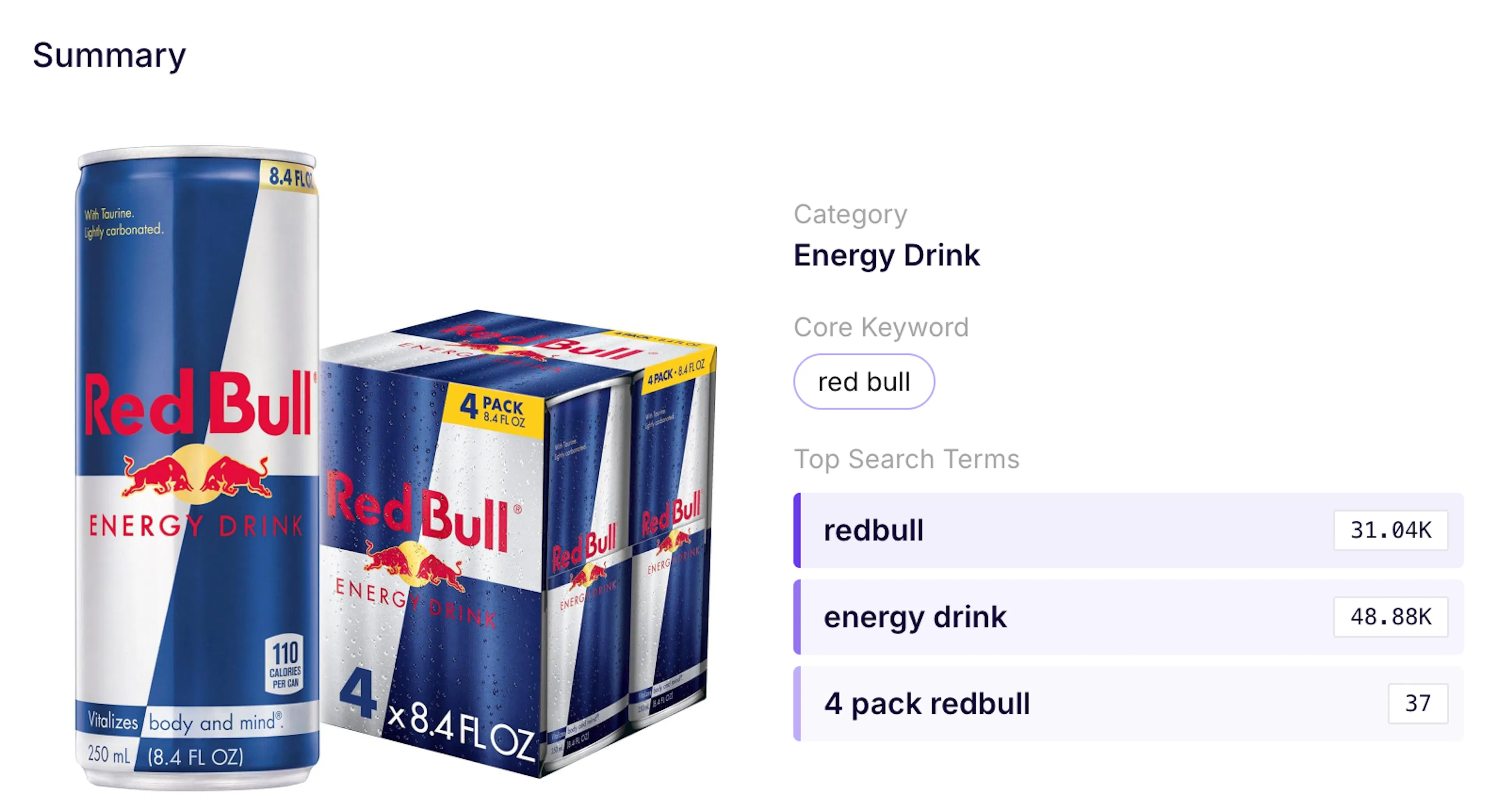
The Category establishes the wider market in which the product’s search activity is being interpreted. The Core Keyword anchors the report to the central product or brand term. Top Search Terms surfaces the leading phrases connected to that context.
Reading the product through the Conversion Funnel
The Conversion Funnel retains the standard Intent methodology, but E-tail anchors it to the search environment generated from the Amazon product.
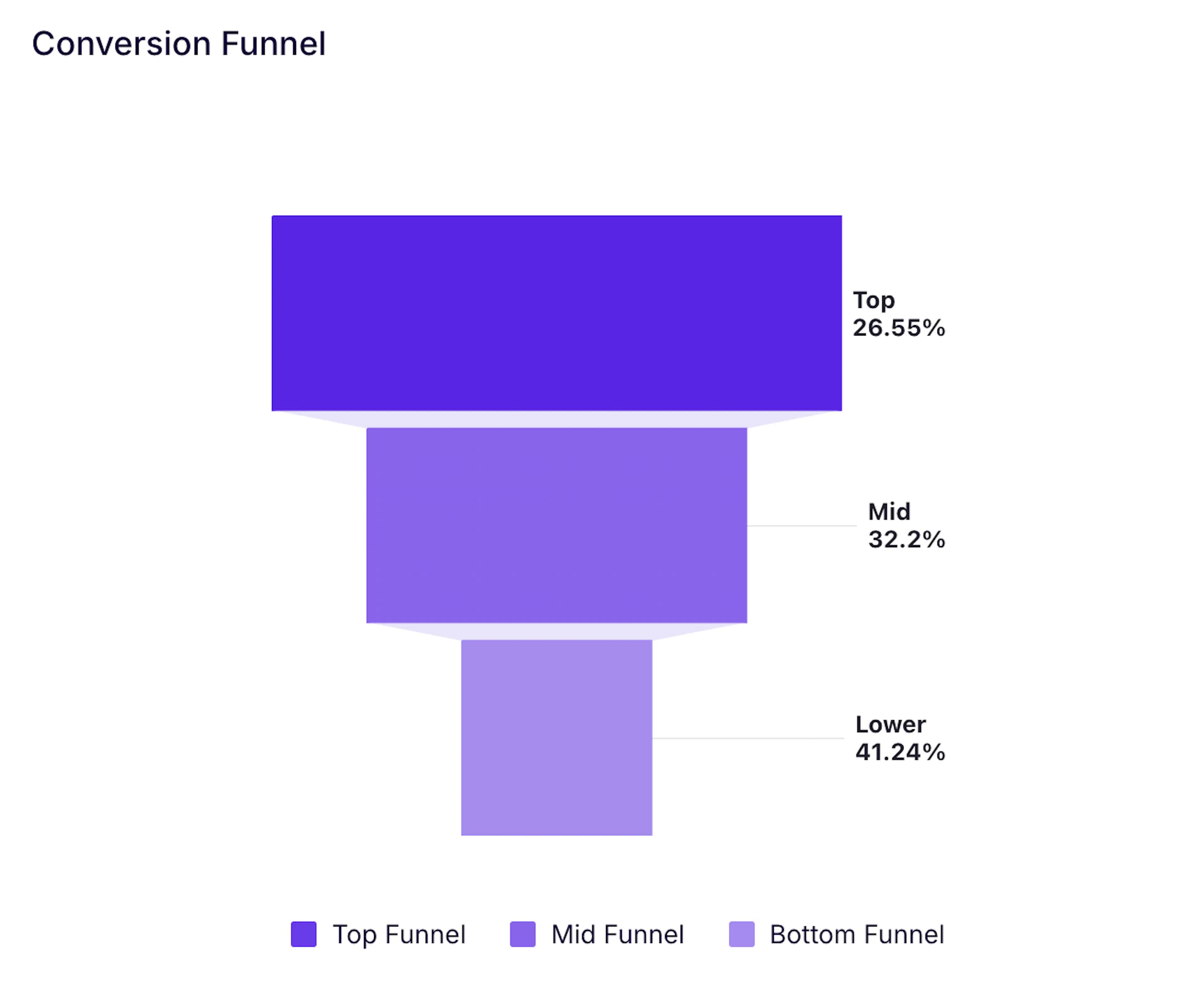
In the example, 26.55% of the search activity sits at the Top Funnel, 32.2% at the Mid Funnel and 41.24% at the Lower Funnel. The largest share is therefore concentrated closer to a defined product decision.
This does not mean that 41.24% of searchers purchased the product. It means the search terms classified as Lower Funnel make up the largest share of the identified search activity. The product is surrounded by a substantial amount of specific, decision-oriented search behavior rather than only broad category curiosity.
The funnel helps researchers understand the maturity of the search environment around the product. A product dominated by Top Funnel searches may require category education or broader awareness. A product with stronger Mid and Lower Funnel activity may sit within a more developed comparison and decision context.
Categories and Top Themes
The Categories and Top Themes sections retain their standard Intent functions, but the Amazon input gives them a specific commercial anchor.
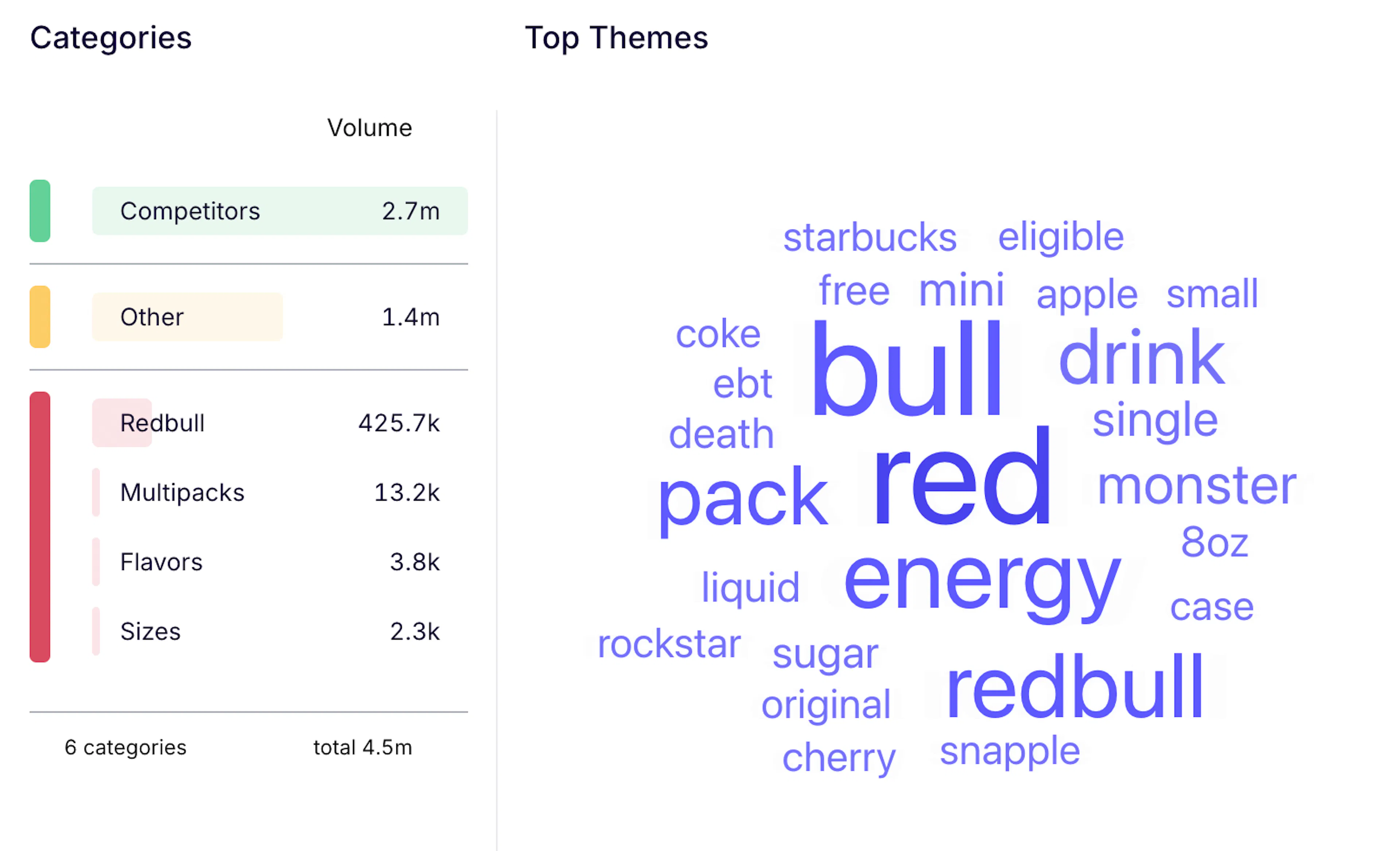
Categories organizes the search activity into the main areas surrounding the product. This can reveal whether the search environment is driven primarily by the core category or whether meaningful activity also exists around competitors, or other product characteristics.
Top Themes exposes the language recurring across those searches. In the example, prominent terms include red bull, energy, drink, pack, and monster. Together, these terms show that the search environment includes branded demand, general category language, product-related searches, and competitor consideration.
The value of this view is not simply keyword discovery. It shows how shoppers mentally organize the space around the product.
Keyword Table
The E-tail Keyword Table shows each search term with its Volume, Funnel stage and Suggested bid.
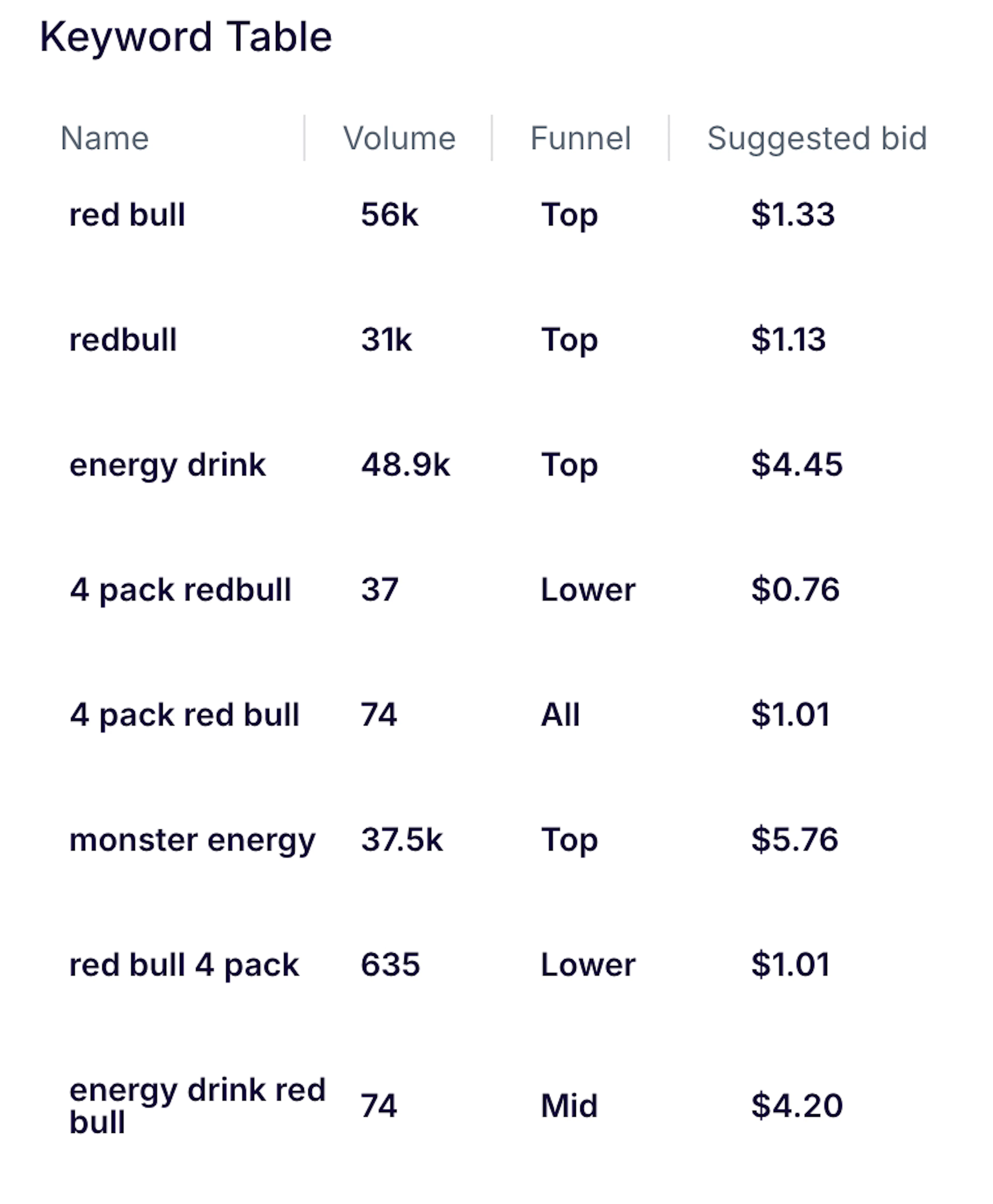
Volume shows the amount of search activity associated with a term. It indicates how prominent the term is within the search environment, not how many sales it produced.
Funnel shows the role of the keyword in the search journey. Top-funnel terms reflect broader discovery, Mid-funnel terms indicate more focused consideration and Lower-funnel terms are more specific and closer to a defined product decision.
Understanding the E-tail additions to Mentions Intelligence
The standard Mentions report examines public conversation around a topic across available sources. E-tail narrows this method to the customer reviews attached to a specific Amazon product listing.
It adds a product-led question:
What have customers concluded about this product after experiencing it, and which parts of the product or purchase experience consistently shape those conclusions?
E-tail answers this through the Product Summary, Key Takeaways, review-based Categories, Topical Keywords & Summary, and Reviews and Comments.
Product Summary
The E-tail Product Summary preserves the specific Amazon listing behind the review analysis. It includes the product title, category, price, overall rating, rating count, Amazon star-rating distribution, number of reviews analyzed, Top Keywords and Top Categories.
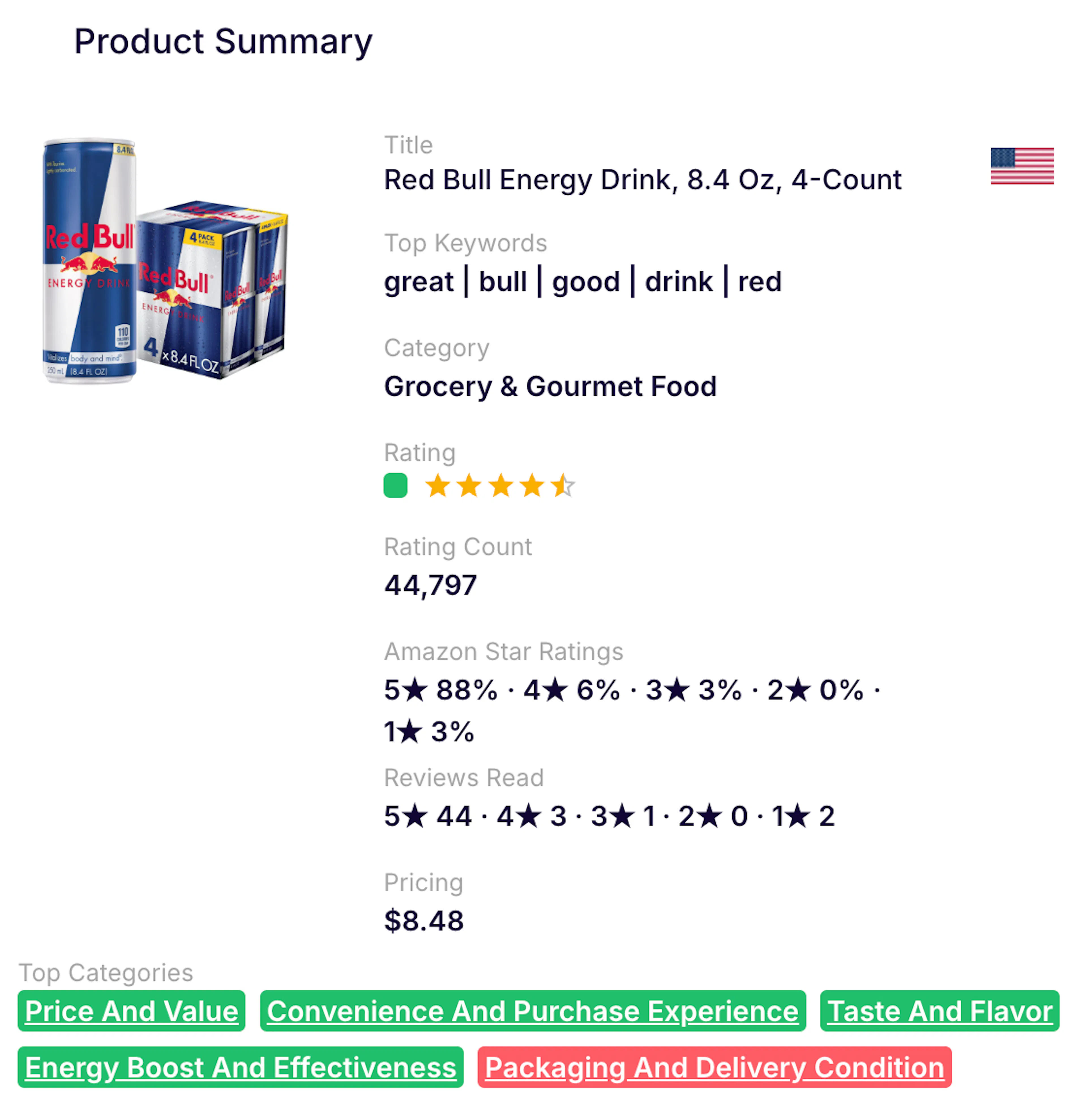
In the example, the product has 44,797 ratings, with 88% at five stars. However, the report also shows how many reviews were actually read and analyzed at each rating level.
The distinction between Rating Count and Reviews Read is important. Rating Count describes the full number of ratings visible on the listing. Reviews Read identifies the review sample used to generate the qualitative findings. The report therefore does not claim that every rating was interpreted as written feedback. Its themes and takeaways are based on the reviews analyzed, while the larger rating distribution provides the surrounding listing context.
The Top Keywords provide an initial view of the language appearing most often within those reviews. The Top Categories show the major areas into which the customer experience has been organized.
Key Takeaways
This card separates the strongest positive findings from the issues that require attention.
Categories
This chart organizes the reviews around the major dimensions of the product and purchase experience. Each category is divided by star rating. This shows not only how often a subject appears, but also how customers rate their experiences when discussing it.
Topical Keywords & Summary
This card uses the language of the reviews to reveal the words and themes that dominate the customer experience. The word cloud provides orientation; the accompanying summaries are required to understand what the words mean in context.
Reviews and Comments
This card preserves the customer statements behind the summaries. It allows researchers to move from an aggregated theme back to the specific experiences shared by individual reviewers.
From product intelligence to AI Twins
E-tail reports can be used as standalone research outputs, but they can also provide the foundation for AI Twin creation.
Behavior Intelligence contributes to the Twin’s Persona by describing the shopper’s demographic, behavioral, lifestyle, and category context. Intent and Mentions contribute to the Twin’s Memories by capturing what shoppers are searching for and how customers describe product experiences in their own language.
This division preserves the difference between who the shopper is and what the shopper currently seeks, considers, or experiences. The resulting AI Twin is not created from a generic customer stereotype, but is grounded in intelligence developed from the selected product listing or product category.
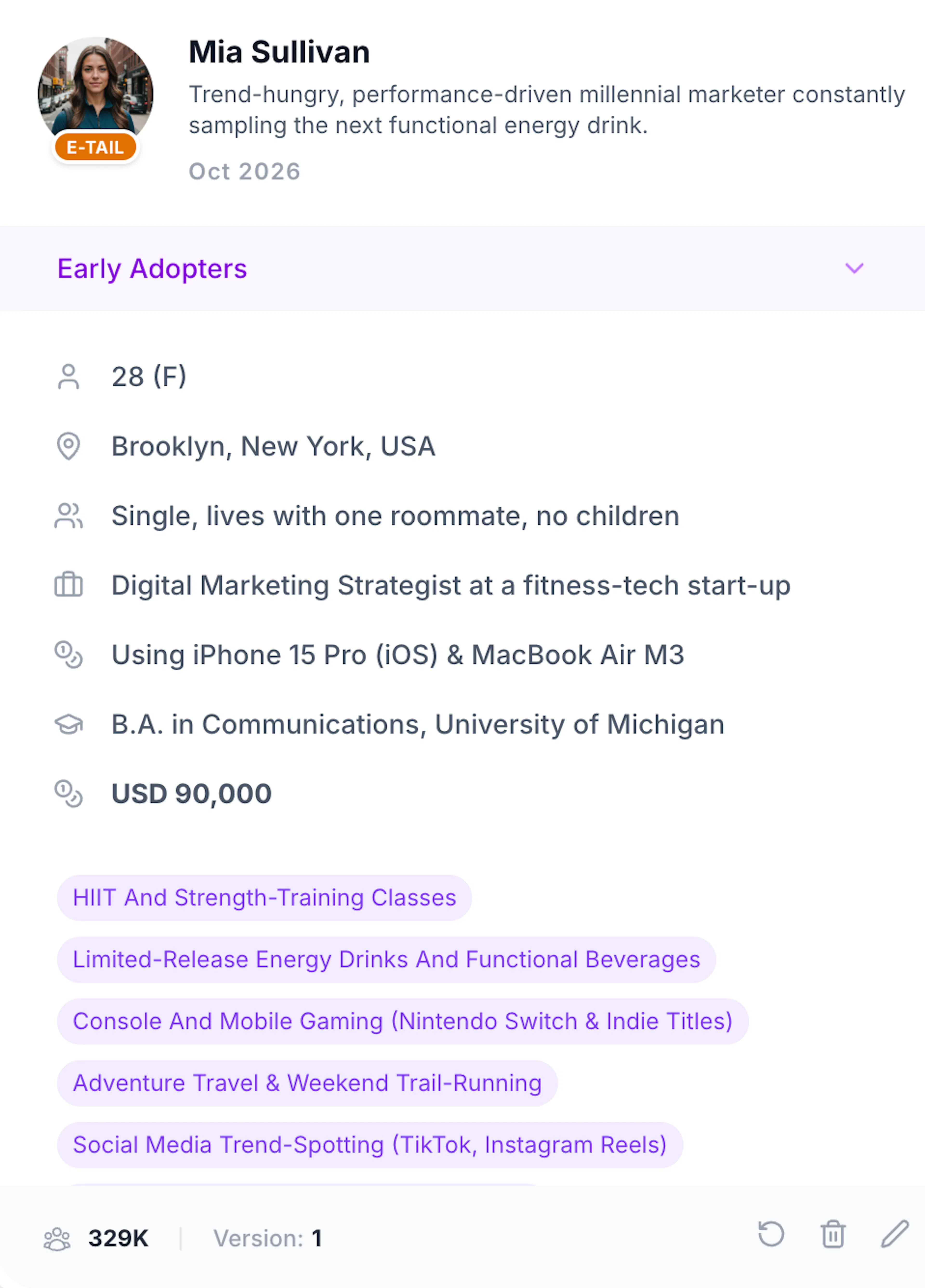
Creating a twin is not required for every E-tail study. A team may use the reports to investigate a category, understand an existing product, or identify an opportunity. AI Twin creation becomes relevant when that intelligence should be carried into later Quantitative Research, Qualitative Research, creative evaluation, or other studies.
What E-tail Intelligence will not tell you
E-tail Intelligence does not measure total market size, total Amazon sales, or the commercial value of a category. It also does not prove that an audience affinity caused a purchase.
A search term indicates search activity, not a completed transaction. A review reflects the experience of a customer who chose to leave feedback, not the views of every purchaser or prospective shopper. A behavioral relationship shows an association within the identified audience, not a universal characteristic of everyone who buys the product.
The Amazon listing also remains the research anchor. Findings developed from one product URL may reflect the specific brand, price, pack format, positioning, availability, and review history of that listing. They should not automatically be treated as conclusions about the complete category or different versions of the product.
When to use E-tail Intelligence
- Use when the research should begin with an Amazon product or product category rather than a predefined audience.
- Use when the team needs to understand the shoppers, searches, and customer experiences surrounding a product.
- Use when a product-led audience needs to be developed for AI Twin creation and subsequent research.
When not to use E-tail Intelligence
- Do not use to generalize findings from one product listing to an entire category without additional evidence.
- Do not use when the research must begin with a precisely defined first-party audience rather than a product or category.