
B1. Creative Tweaking
Evaluate a single creative or compare multiple options, understand how the selected AI Twins respond, and turn the findings into a clear direction for the next creative.
What is Creative Tweaking?
Creative Tweaking is a qualitative Creative & Content method on consumr.ai that evaluates multiple creative assets together and explains which option performs most strongly for the selected campaign objective.
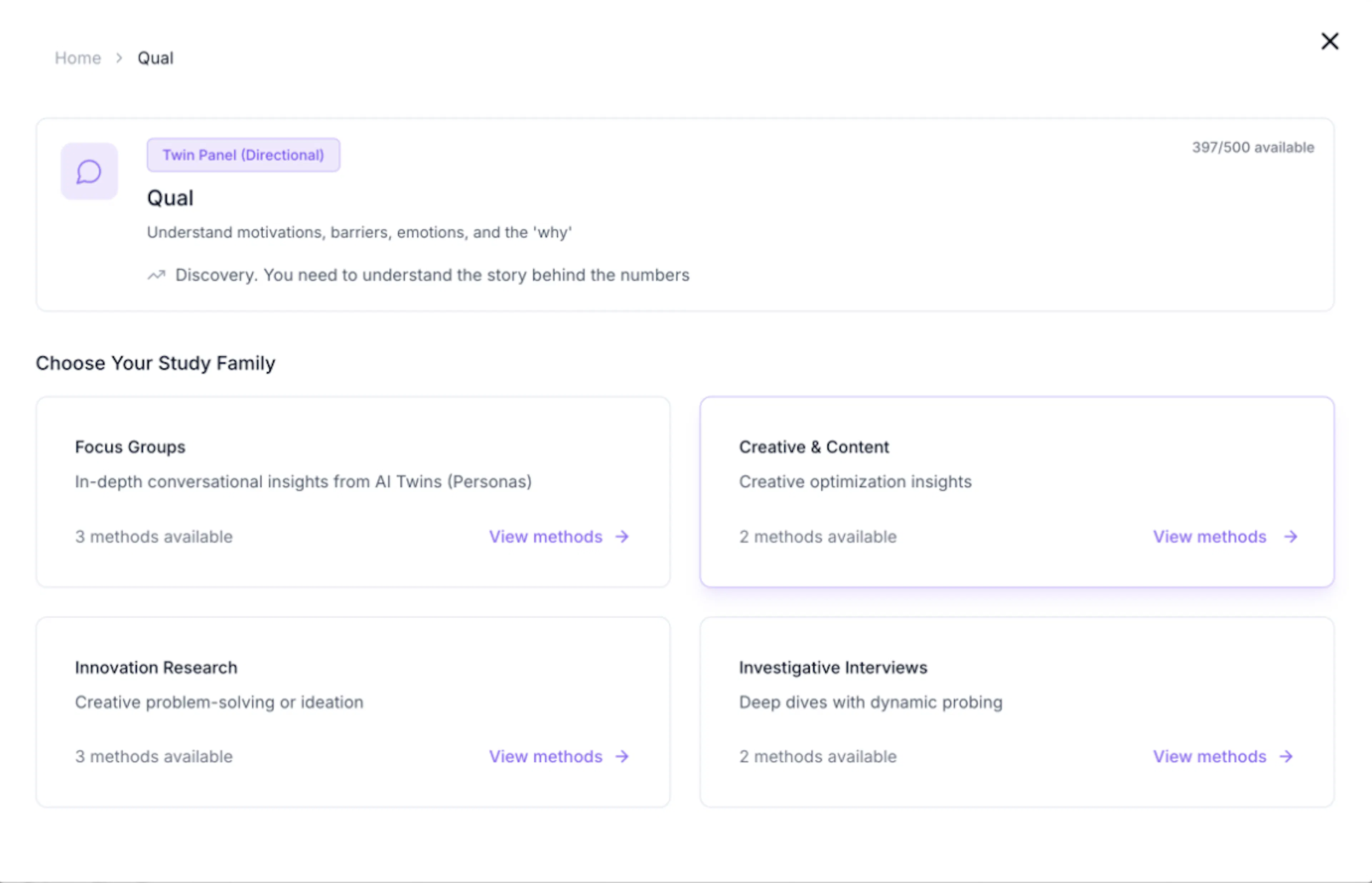
It sits inside the Creative & Content module within Qualitative Research. The path is:
| Qualitative Research → Creative & Content → Creative Tweaking |
|---|
Creative Tweaking can be used in two ways. A Single Creative study evaluates one asset and identifies what is working, what is creating friction, and what should change. A Compare study evaluates multiple assets together, identifies the strongest option for the selected objective, and explains what creates the difference between them.
Who needs Creative Tweaking?
Creative Tweaking is for teams that have two or more creative options and need to decide which direction should move forward before launch, media investment, or another production cycle begins.
It is useful for creative leads, brand teams, agencies, growth marketers, and campaign managers working with ad images, ad copy, videos, or landing pages. The assets may be near final, or they may still be alternative routes competing for the same brief.
Use Single Creative when one execution needs a structured audience assessment. The asset may be an early direction that needs refinement or a near-final execution that needs to be checked for clarity, appeal, relevance, and brand alignment.
Use Compare when two or more creatives are competing for the same purpose. The study can show which option performs most strongly, what creates its advantage, and which elements from the other options should still be carried into the next iteration.
In both cases, the objective is practical. The team should leave the study knowing what the audience responded to, what weakened the creative, and what to do next.
What Creative Tweaking measures
Creative Tweaking measures how the selected AI Twins respond to the creative set under a consistent objective-led framework. The campaign objective determines which parameters are included and how strongly each one contributes to the final result.
Depending on the objective and creative type, the parameter set may include Attention, Distinctiveness, Clarity, Brand Recall, Emotional Pull, Visual Flow, Readability, Trust, offer clarity, or call-to-action strength.
A creative may be highly distinctive but unclear. Another may be easy to understand but fail to earn attention. A third may perform well across most parameters but lose on the criteria that carry the greatest weight for the selected objective. Creative Tweaking surfaces these trade-offs before the team commits spend.
Why Creative Tweaking matters
Creative review often happens among the people who created, commissioned, or approved the work. The intended audience is discussed, but the decision can still be driven by internal preference, hierarchy, or familiarity with the concept.
Creative Tweaking introduces a consistent audience perspective before the work becomes expensive to change. A Single Creative study can reveal issues that might otherwise be repeated across a campaign. A Compare Creatives study can make the trade-offs between different routes visible and explain why one option has an advantage.
The purpose is not to replace creative judgment. It is to give creative teams a clearer audience signal and a structured explanation that can inform their judgment. This makes it easier to protect what is working, address what is weakening the creative, and build the next version from evidence rather than internal preference alone.
Single Creative vs Multi Creative Compare
Single Creative and Multi Creative Compare support different decisions.
Single Creative is diagnostic. It asks how one asset performs, what the AI Twins respond to, what creates friction, and how the asset can be improved. It does not identify a comparative winner because there are no competing options in the study.
Compare Creatives is relative. It asks which option performs most strongly against the selected objective and why. The result depends on the differences within the submitted set. It includes comparative analysis and a Gold Standard that brings the strongest findings across the assets together.
The two study types should not be interpreted as interchangeable reports. A strong score in a Single Creative study describes the assessment of that asset. A winner in Compare Creatives describes the asset’s position relative to the other options in that particular study.
Objectives That Belong to the Format
Images, videos, landing pages, and ad copy follow the same broad research structure, but they are not assessed against the same objectives or parameters. Each format is evaluated according to what it is capable of doing.
Ad Image
An Ad Image can be evaluated for Awareness, Consideration, Conversion, or Post-Purchase.
An Awareness assessment may give greater importance to whether the image earns attention, feels distinctive, makes the brand visible, and supports recall. A Conversion assessment may focus more closely on whether the offer is clear, credible, persuasive, and easy to act on.
Ad Video
An Ad Video can be evaluated for Attention Harvesting, Mental Availability, Problem and Solution Framing, Objection Liquidation, or Immediate Intent.
Video is assessed as an experience that develops over time. Under Attention Harvesting, the assessment examines the opening seconds, the visual hook, how early the brand becomes visible, the pacing, and whether the video holds interest. Under Problem and Solution Framing, the emphasis moves toward how clearly the problem is established and how convincingly the product provides the solution.
The same video can therefore be read differently under different objectives because each objective asks it to perform a different job.
Landing Page
A Landing Page can be evaluated for its ability to communicate a value proposition, educate a visitor, build trust, reduce objections, or drive a transaction.
These objectives can place emphasis on message hierarchy, benefit communication, navigation, proof, usability, objection handling, or the clarity of the path to action. A page intended to educate a visitor should not be assessed through exactly the same parameters as a page intended to complete a transaction.
Ad Copy
Ad Copy can be evaluated for Reach, Traffic, Engagement, Video Views, Lead Generation, Sales, App Installs, or Store Visits.
Copy designed to generate engagement may be assessed for its relevance and ability to prompt interaction. Copy designed to drive sales may receive greater scrutiny on benefit communication, persuasive clarity, credibility, urgency, and the call to action.
The objective determines which aspects of the creative receive the closest attention. It is not simply a report label.
How the AI Twins and Brand Guidelines Shape the Assessment
The selected AI Twins form the qualitative audience for the study. Their perspectives determine how the creative is interpreted, which elements generate a positive response, and where friction appears.
The creative format and objective determine the assessment framework. consumr.ai generates a standardized set of evaluative questions for that combination so that the asset is examined according to its intended purpose. In a comparative study, every creative is assessed under the same framework.
Creative Tweaking also inherits the Brand Guideline connected to the Brand Portfolio. This gives the assessment access to the brand’s logo assets, colors, fonts, text styles, imagery direction, voice, messaging hierarchy, and other recorded standards.
Audience response and brand alignment are related but separate considerations. A creative may appeal to the selected AI Twins while departing from the brand’s established identity. It may also follow the Brand Guideline closely while communicating the campaign message poorly. Creative Tweaking provides context for examining both.
What a Creative Tweaking study produces
The report depends on whether the study evaluates one creative or compares multiple creatives. A Single Creative report diagnoses one asset on its own. A Comparative report establishes relative performance across a set of assets and develops a combined direction for the next creative.
Single Creative Report
A Single Creative report begins with an overall Creative Assessment. This includes a concise verdict, a summary of how the creative performs against the selected objective, a score out of 10, and a performance classification.
The assessment also identifies the creative’s Top Strength and Top Weakness. These establish the most important element to preserve and the most significant issue limiting the creative.
Parameter Feedback
The Parameter Feedback table evaluates the creative against the parameters generated for its format and objective. Each parameter includes a rationale explaining the assessment, supported by the specific pros and cons identified by the AI Twins.
The parameters change according to the creative format and selected objective. For example, a video evaluated for Attention Harvesting may be assessed on First 3 Second Disruption, Scroll-Stopping Visual Hook, Curiosity Gap, Thumb-Stopping Relevance, Motion & Pace Energy, Sound or Text Trigger, Early Brand Visibility, and Watchability Beyond Hook. A different video objective would produce a different assessment framework.
This makes the report diagnostic rather than comparative. It explains how the creative performs, which execution choices support the objective, and where the asset begins to lose clarity, relevance, attention, or persuasive strength.
Key Takeaways & Action Plan
The Key Takeaways & Action Plan converts the assessment into a prioritized direction for revision. Each recommendation identifies a specific improvement and explains how it can strengthen the creative.
The recommendations may address pacing, message clarity, brand visibility, value proposition, product demonstration, call-to-action strength, or audience relevance, depending on the format and objective. Together, they provide a practical brief for improving the submitted creative.
Comparative Report
A Comparative report evaluates multiple creatives under the same format, objective, question set, and AI Twin audience. It identifies the strongest option within the uploaded set and explains the differences that produced the result.
Comparative verdict
The comparative verdict identifies which creative performed most strongly within the uploaded set for the selected campaign objective. This is not an isolated score. It is a head-to-head result produced under the same evaluation conditions.
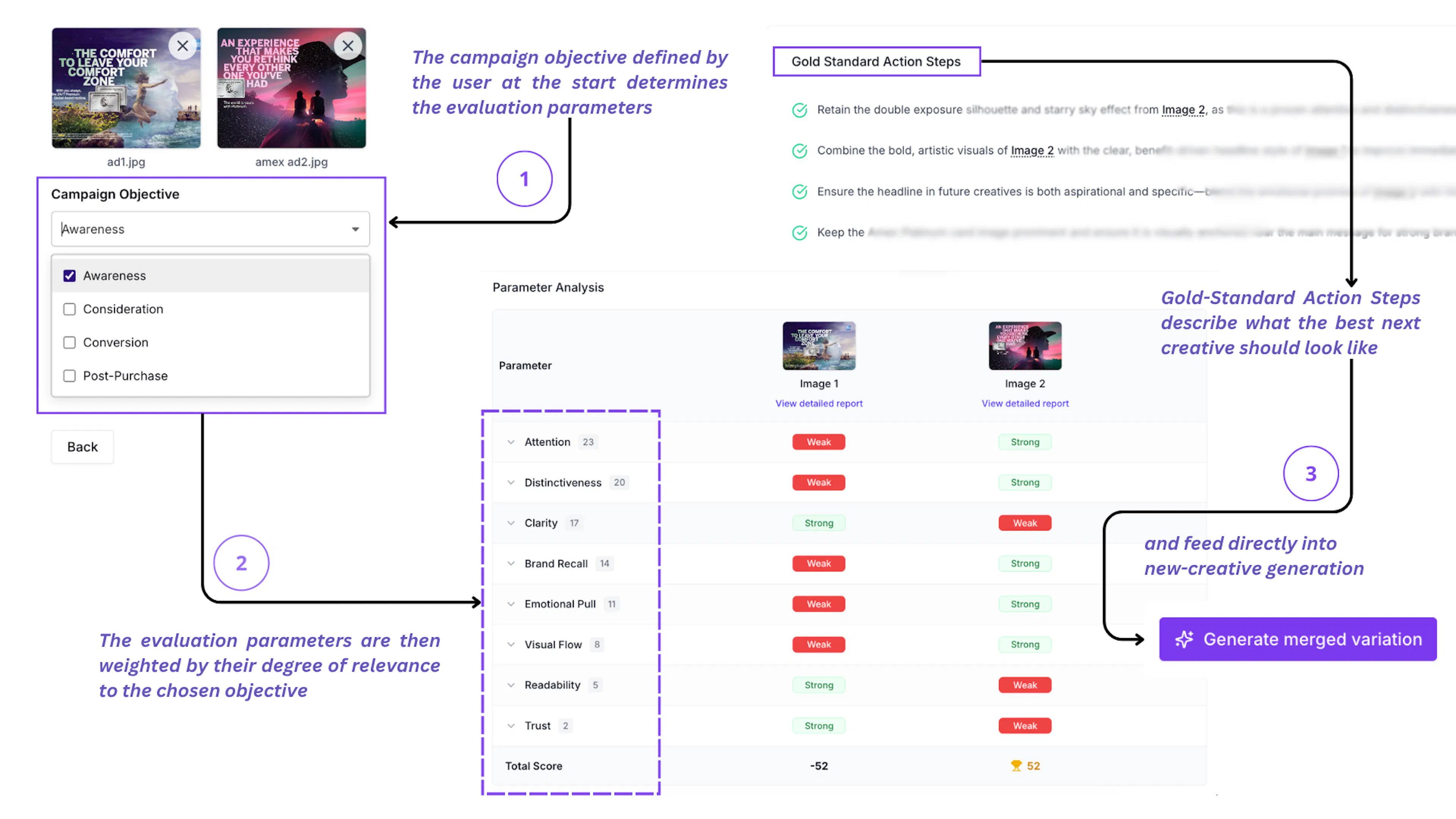
Parameter analysis
The Parametric Analysis shows how every creative performed across the criteria used in the assessment. Each parameter is classified as Strong, Average, or Weak and supported by a rationale.
- Strong means the creative clearly delivers the requirement and creates a comparative advantage.
- Average means the requirement is present but does not meaningfully separate the creative from the alternatives.
- Weak means the creative underdelivers on the requirement or creates a disadvantage in the comparison.
For example, one creative may score Strong on Attention because its central visual is immediately noticeable, but Weak on Clarity because the headline, product, and background compete for attention. Another creative may communicate the benefit more clearly but feel less distinctive. The matrix makes these trade-offs visible.
Weighted score
The total score is a weighted summary of the parameter results. Parameters that matter more to the selected campaign objective contribute more heavily to the result. In an Awareness assessment, Attention, Distinctiveness, and Brand Recall may carry greater influence. In a Conversion assessment, Clarity, offer communication, Trust, and call-to-action strength may matter more.
This means a creative can perform well on several lower-priority parameters and still lose if it is weak on the criteria that are most important to the objective. Use the total score to understand the ranking. Use the parameter rationales to understand what created the ranking.
Delta reasoning
Delta reasoning explains why one creative performs better than another at the parameter level. It identifies the choices creating the gap, such as a stronger attention device, clearer message hierarchy, better brand linkage, greater emotional relevance, or more credible proof.
The value of delta reasoning is that it turns a comparison into a creative decision. The team can see which elements should be retained and which changes are most likely to improve the weaker routes.
Gold Standard
The Gold Standard converts the collective assessment into a blueprint for the ideal next creative. It does not simply copy the winning asset. It combines the strongest available elements across the complete set and identifies:
- what to retain from the stronger creatives
- what to improve or remove from the weaker creatives
- what is missing across the complete set and should be added next
For example, the Gold Standard may recommend retaining the attention-driving visual from one image, combining it with the clearer headline structure from another, improving the contrast between headline and background, and adding a tangible product benefit that none of the current options communicate.
Generate Creative Variations
A new creative can be generated directly from the Gold Standard in the same workflow. The generated direction is based on the comparison across all uploaded assets, rather than on a rewrite of one original creative.
The generated output should be treated as an informed starting point. Final brand, legal, and production review still belongs to the creative team.
Walkthrough of How to Interpret a Creative Tweaking Report
What Creative Tweaking will not tell you
Creative Tweaking does not estimate how the broad market will respond. The result reflects the selected AI Twins and provides a focused qualitative read, not a population-scaled forecast.
In a Comparative study, the result is meaningful only when the submitted creatives are genuinely comparable. They should be the same creative format, address the same campaign objective, target the same audience, and be developed to a similar level of polish. A finished asset compared with an early concept, or creatives designed for different objectives or contexts, can produce differences that reflect the setup rather than the quality of the creative direction.
The comparative verdict identifies the strongest option within the submitted set. It does not establish that the winning creative is universally effective or stronger than options that were not included in the study.
A strong Single Creative score or a comparative winner also does not guarantee in-market performance. Media placement, targeting, frequency, competitive activity, production quality, and the surrounding customer experience can all affect results after launch.
When the team needs to validate preference or response at scale, the refined options should be taken into Quant Creative Testing.
How Creative Tweaking differs from Content Optimization
Creative Tweaking compares discrete creative assets such as ads, landing pages, and videos. Its output is a comparative scorecard, parameter reasoning, and a Gold Standard. Content Optimization on the other hand, is used for long-form written material such as emails, articles, and web copy. Its purpose is to improve the content through marked-up edits and before-and-after guidance rather than rank multiple creative executions.
How Creative Tweaking differs from Quant Creative Testing
Creative Tweaking and Quant Creative Testing both evaluate creative, but they answer different questions.
Creative Tweaking explains which route is stronger, what creates the difference, and what the next creative should contain. Quant Creative Testing measures response at scale and helps estimate how preference or performance may distribute across a larger audience.
A team may use both in sequence. Creative Tweaking can first compare and improve the available routes. Quant Creative Testing can then validate the polished options at scale.
When to use Creative Tweaking
- Use Single Creative study when one image, video, landing page, or piece of ad copy needs to be evaluated and improved without comparison.
- Use Multi Creative compare when multiple creative routes are competing for the same brief and the team needs to select one.
- Compare Creatives only when the assets share the same format, objective, intended audience, and context, and have a similar level of polish.
- Use it before launch while the creative is still changeable and the findings can inform the next iteration.
- Use it before Quant Creative Testing when obvious qualitative issues should be corrected first.
When not to use Creative Tweaking
- Do not use it when the primary need is a population forecast or audience sizing.
- Do not use Multi Creative compare when the assets are too different in purpose or level of polish to support a fair comparison.
- Do not use it when the material is long-form content requiring line-by-line editing.
- Do not treat the winning score as a guarantee of campaign performance.
Limitations
The selected AI Twins shape the result. A different audience perspective may produce a different ranking.
Objective selection shapes the weights. A creative may win for Awareness and lose for Conversion.
Creative polish can influence the comparison. Keep execution quality consistent across options.
The study explains individual or comparative performance but does not replace in-market validation.
The Gold Standard is a direction for the next creative, not an automatic guarantee of success.
How to Run a Creative Tweaking Study
Creative Tweaking helps you compare multiple creative options against a selected campaign objective, understand why one route performs better, and create a Gold Standard for the next iteration.
Navigation path:
| Calendar → New Event → New Research Study → Qual → Creative & Content → Creative Tweaking |
|---|
Walkthrough of how to create a Creative Tweaking study
Step 0: Go to Creative Tweaking
Log in to consumr.ai. From the dashboard, open Calendar, click New Event, and then choose New Research Study.
From the research study selection screen, select Qual. Then select Creative & Content.
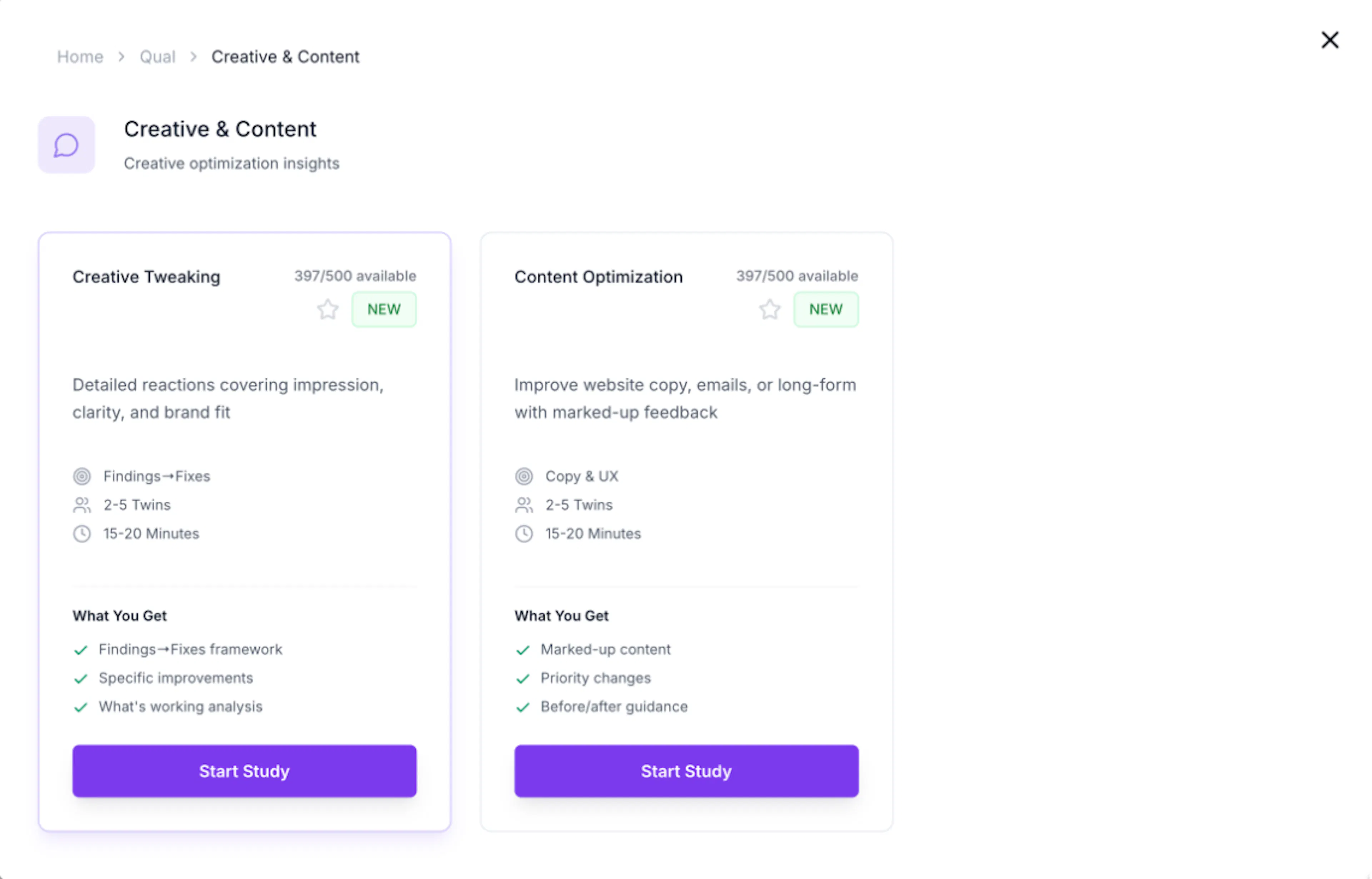
On the Creative & Content landing page, you will see Creative Tweaking and Content Optimization. This guide covers Creative Tweaking.
Step 1: Start a Creative Tweaking study
Find the Creative Tweaking card and click Start Study. The card summarizes the format and the outputs available from the study, including comparative findings, specific improvements, and direction for the next creative.
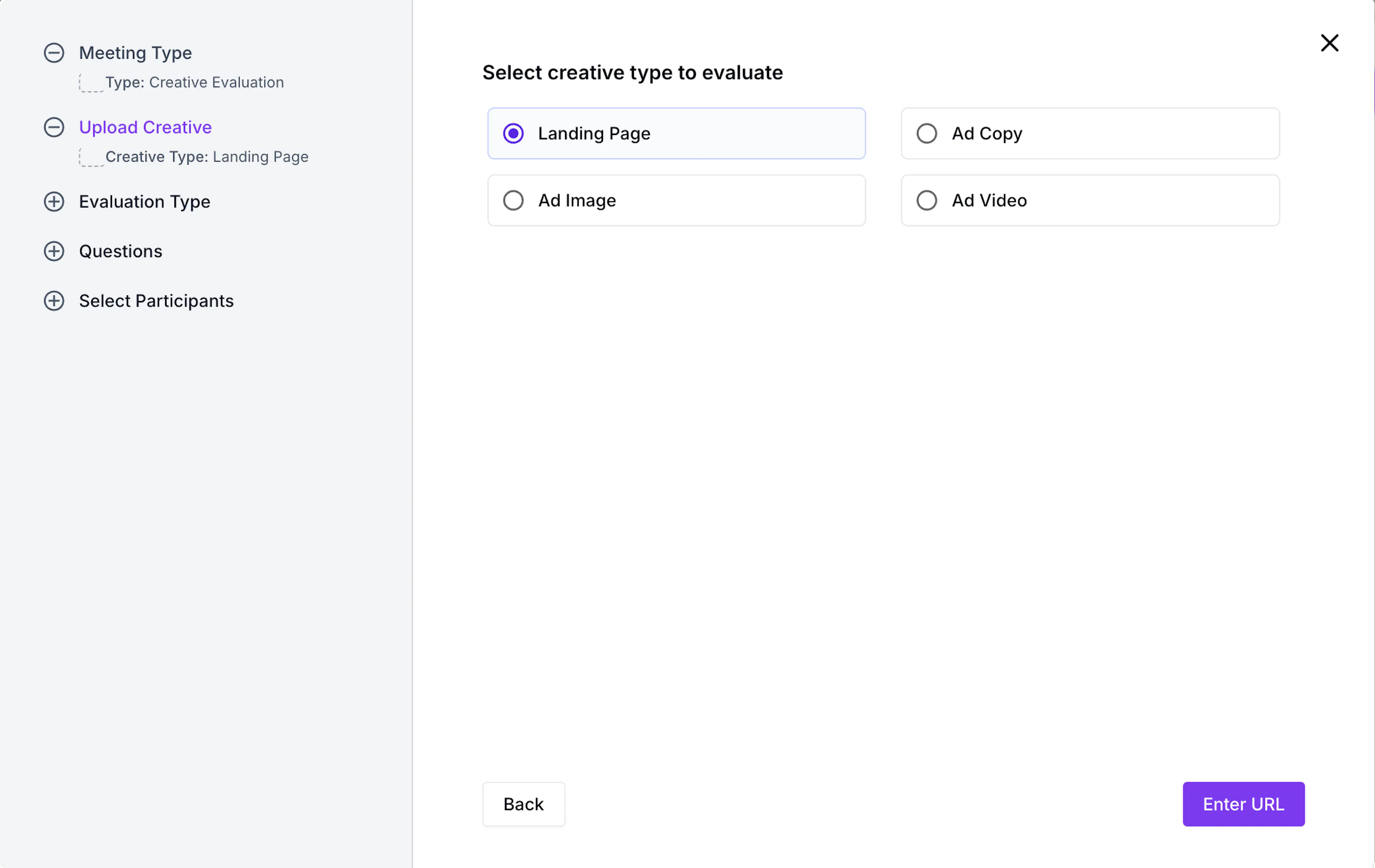
Step 2: Select the creative type
Choose the format that matches the assets being assessed: Landing Page, Ad Image, Ad Copy, or Ad Video. The selected type determines the upload or entry fields used on the next screen.
Step 3: Upload one or more creative options and select the campaign objective
Upload or enter one or more creative options that need to be studied. For Ad Image studies, select the relevant platform and upload the images. Keep the assets comparable in purpose and level of polish.
Next, select the Campaign Objective. The objective controls the evaluation parameters and their weights, so it should match the actual brief.
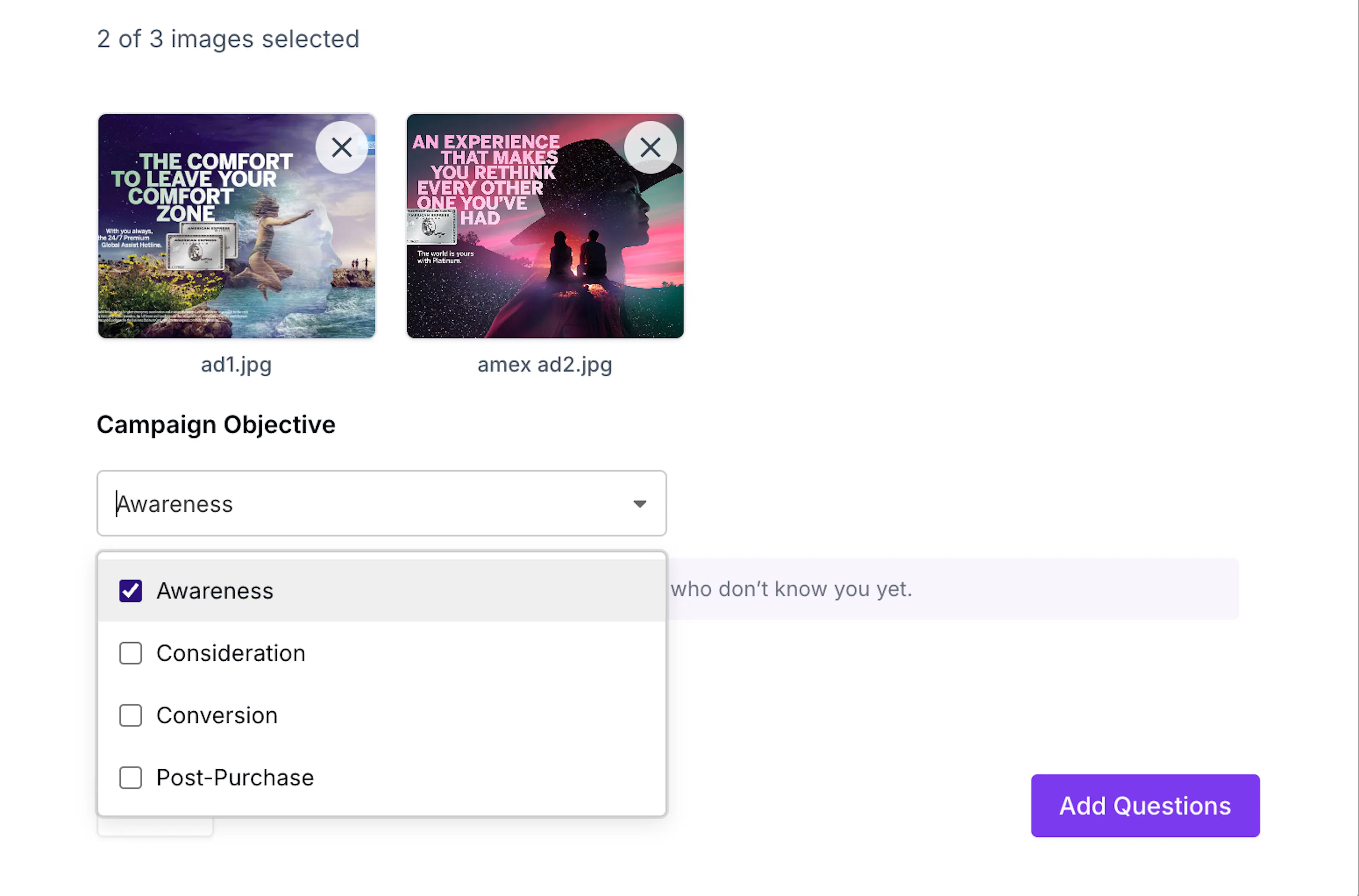
For example, selecting Awareness gives greater importance to attention, distinctiveness, and recall. Selecting Conversion places more emphasis on clarity, persuasive communication, trust, and call-to-action strength.
Once the creatives and objective are ready, click Add Questions.
Step 4: Review the evaluation questions
When the study enters the Questions phase, the system automatically generates a highly detailed, standardized corpus of evaluatory questions based on the creative type, uploaded options, and selected campaign objective. These questions define the exact hypotheses the AI Twins will analyze and ensure that every creative is assessed under the same qualitative testing conditions.
The question corpus cannot be edited, deleted, replaced, or supplemented.
This protects the objectivity and consistency of the assessment by preventing the evaluation criteria from being changed to favor a particular creative or expected outcome.
Review the generated corpus to understand what the assessment will test, then click Select Twins to continue.
Step 5: Select the AI Twins
Choose the AI Twins whose perspectives should shape the assessment. The Twins should represent the people the campaign is intended to reach and the consumer tensions the creative must resolve.
A varied but relevant set can show whether one creative performs consistently or whether its strength depends on a particular mindset.
Do not select Twins only for diversity; select them because their perspective is relevant to the decision.
At the bottom of the screen, Conduct Meeting Once runs a single assessment. Start Meeting and Schedule creates a recurring run. For a one-time creative decision, select Conduct Meeting Once.
Step 6: Review the comparative verdict
After the assessment finishes, the report opens with the submitted creatives and a concise verdict. The verdict identifies the strongest creative in the set and summarizes the reasons it leads.
Read this section as the answer to the decision question, not as the full explanation. The sections below show how the verdict was produced.
Step 7: Read the Parameter Analysis
The Parameter Analysis compares every creative across the objective-led criteria. Each row represents a parameter and each creative is marked Strong, Average, or Weak.
The number shown beside each parameter is its weight. A higher weight means the parameter has greater influence on the total score because it is more important to the selected campaign objective.
In the example, one image performs strongly across the highest-weighted awareness parameters, including Attention and Distinctiveness, while the competing image is weaker on those dimensions. The winning image therefore leads even though the other creative may perform better on lower-weighted criteria such as Readability or Trust.
How to interpret the matrix: Start with the highest-weighted rows. These explain the largest part of the final score. Then inspect the lower-weighted rows to identify weaknesses that should be repaired without removing the winning elements.
Step 8: Detailed analysis for an individual creative
An individual analysis on the other hand is a deeper diagnostic of that creative alone, rather than another comparison between the uploaded options. The original creative appears at the top of the page so every finding can be reviewed against the exact asset that was submitted.
The Creative Assessment section provides a concise summary of the creative, its key highlights and an overall score out of 10. Scores below 5 are considered Weak, scores from 5 to 7 are considered Average, and scores above 8 are considered Strong. Directly below the summary, the report highlights the creative's Top Strength and Top Weakness so the most important positive and negative signals can be reviewed at a glance.
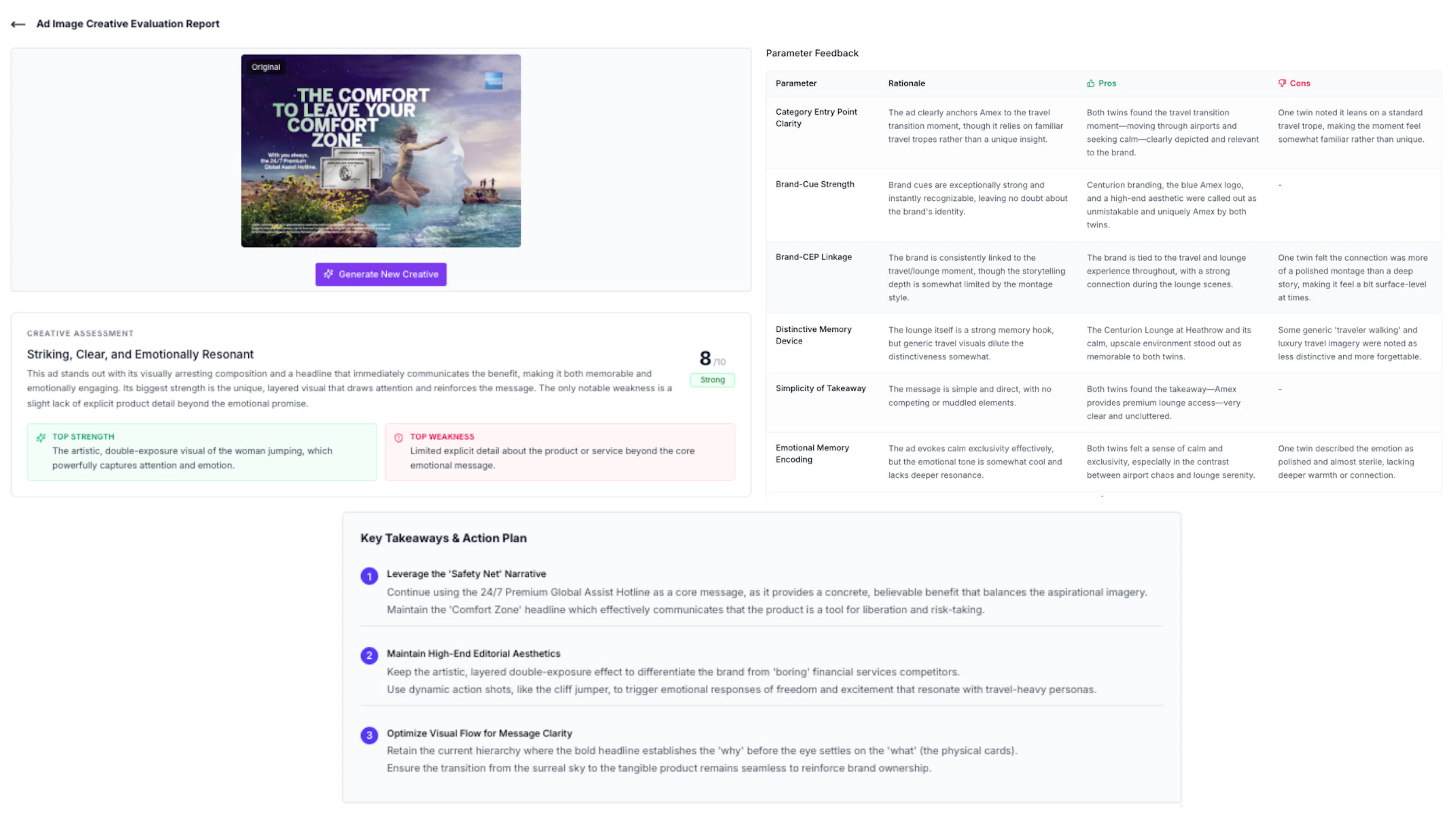
The Parameter Feedback section then breaks the assessment down criterion by criterion. For each parameter, the report shows the rationale behind the response and the corresponding Pros and Cons raised by the AI Twins. This makes it possible to understand not only how the creative performed, but which specific visual, message or brand choices produced that result.
The Key Takeaways & Action Plan at the bottom of the page provides strategic recommendations for improving this individual creative only. These recommendations should not be confused with the later Gold Standard, which combines findings across the full creative set.
Step 9: Review the Gold Standard Action Steps & generate variations
The Gold Standard Action Steps combine the strongest findings across all creatives into a practical direction for the next iteration.
The recommendations are organized around three decisions: what to retain from the strongest assets, what to improve from weaker assets, and what to add because the complete set is missing it.
In the example, the action steps retain the strongest attention-driving visual, combine it with clearer copy from the alternative image, preserve the strongest emotional tone, improve headline contrast and readability, and add a more tangible product benefit.
At the bottom of the Gold Standard section, click Generate merged variation to create a new creative based on the action steps.
The generated output is not simply a copy of the winning asset. It is intended to combine the most effective elements from the creative set while correcting the weaknesses identified in the assessment.
Review the generated creative against the Gold Standard before using it. Confirm that the winning elements were retained, the identified weaknesses were addressed, and the output still meets brand, legal, and production requirements.
Step 11: Use the result in the next decision
The end of the study should produce three things the team can act on: a winning route, an explanation of why it wins, and a specification for the next creative.
Use the verdict to choose the direction. Use the parameter analysis and feedback to brief the edits. Use the Gold Standard to create or commission the next version. When population-level validation is required, take the refined options into Quant Creative Testing.