

Content Optimization
Evaluate blogs, webpages, landing pages and emails through a selected panel of AI Twins, then use the panel response to guide revisions.
What Content Optimization is
Content Optimization is a Qualitative Research study for written content that is developed enough for an audience to evaluate. It helps teams understand how selected AI Twins receive a blog, webpage, landing page or email, what strengthens or weakens the experience, and what should change before the content is published or used more widely. The purpose is not simply to judge whether the writing sounds polished. It is to examine whether the content works for the audience and the role it is meant to perform.
Who needs Content Optimization
Content Optimization is useful for content, marketing, brand, product and customer experience teams that need to improve written material before publication or wider use. It is especially relevant when internal reviewers agree that something is not working but cannot identify whether the problem is clarity, tone, relevance, information hierarchy or the next step being asked of the audience.
The study can also support agencies and research teams that need an audience-based explanation they can share with stakeholders. It provides a common evidence base for discussing what to preserve, what to revise and why, without reducing the decision to personal writing preference.
Why Content Optimization matters
Internal reviewers approach content with knowledge that the audience may not have. They already understand the product, the intended message and the desired next step. That familiarity can make a missing explanation, unclear transition, buried product detail or weak call to action feel more obvious than it is. AI Twins provide an audience-grounded perspective, allowing the team to see where the intended meaning is clear and where the experience creates friction.
The central principle is that content is not effective in the abstract. Its effectiveness depends on where it appears, who encounters it and what that person is expected to understand or do next. Content Optimization exists to evaluate that relationship rather than reward polished language alone. It supports editorial judgment by connecting a proposed edit to a specific audience or communication problem.
What Content Optimization evaluates
Content Optimization uses a set of questions tailored to the submitted content. The evaluation focuses on qualities that affect how the content is received, including clarity, tone, relevance and whether the message gives the audience a credible reason and path to act.
The same writing choice can help one format and weaken another. A detailed narrative may make a blog more useful, but it can slow a landing page when the visitor is ready to act. A concise message may suit an email, while the same amount of information may leave a webpage or article incomplete. Content Optimization therefore uses the selected content style as part of the evaluation rather than applying one generic standard to every asset.
| Content style | Role of the content | What the evaluation needs to consider |
|---|---|---|
| Blog | Explain a subject and sustain attention. | Whether the topic is understandable, sufficiently developed and organized for continued reading. |
| Webpage | Help visitors understand the brand or offering and locate a relevant next step. | Whether the information hierarchy supports orientation, clarity and navigation toward the intended action. |
| Landing page | Move a defined audience toward a focused action. | Whether product or offer information, proof and calls to action are easy to find without decision friction. |
| Earn attention quickly and motivate a response within limited space. | Whether the message is immediately relevant, concise enough for the format and clear about what the recipient should do next. |
The content style provides the functional context for the report. The selected AI Twins provide the audience context. Both are necessary: format explains what the content must accomplish, while the audience explains which needs, motivations, and expectations shape the response.
How AI Twins shape the assessment
The selected AI Twins form the audience panel for the study. Their responses provide directional Qualitative Research evidence about how that audience may interpret the content. Audience selection therefore changes the meaning of the result. A score and reaction describe how the submitted version was received by those selected perspectives. A different audience may bring different needs, expectations, or objections and may respond differently to the same content.
What a Content Optimization study produces
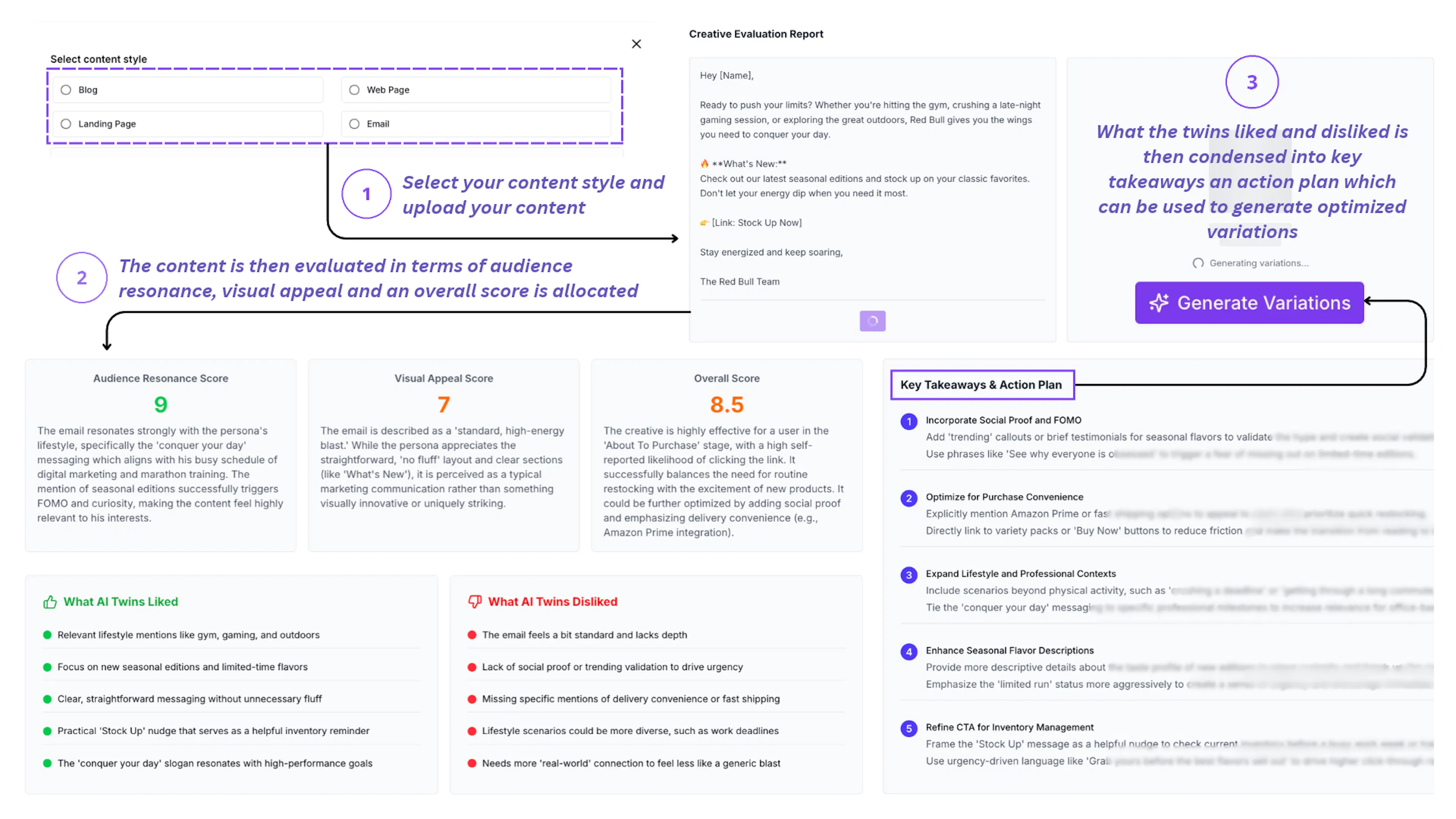
The final evaluation report works at three levels. Audience Scores provide the quickest reading of the panel response and sit alongside what the AI Twins liked and disliked. Key Takeaways summarize the themes that matter most across the panel. AI Twin Detailed Feedback then provides each Twin's score and conversational transcript, allowing researchers to inspect the individual evidence behind the summary.
Audience Scores
The report opens with Audience Scores showing how the panel rated the content. Scores make the result easy to scan and compare, but they should not be interpreted on their own. The explanations and the paired likes and dislikes show which content choices contributed to the reaction and which choices created friction.
Audience Resonance Score. This score summarizes how strongly the content connects with the selected AI Twins. The explanation shows which audience needs, goals or expectations the content supports and where the message feels irrelevant, incomplete or misaligned. Resonance is audience-specific. A strong result with one set of AI Twins does not establish that every market or segment will respond in the same way.
Visual Appeal Score. This score considers how the presentation and organization support the experience where visual structure is relevant. It may reflect hierarchy, scanability, imagery, section clarity or the way the page guides attention. Visual strength does not automatically mean the content is effective. A page can look polished while hiding product information or making the intended action difficult to find.
Overall Score. The Overall Score brings the evaluation together into a single directional result. It should be interpreted alongside Audience Resonance, Visual Appeal and the written rationale. The report does not expose a calculation that should be treated as a predictive formula, and the score is not an estimate of clicks, conversion, sales or future campaign performance.
What AI Twins Liked and Disliked
What AI Twins Liked identifies the choices that supported the response, such as relevant language, clear organization, useful product categorization, an appropriate level of detail or a call to action that fits the audience's situation. What AI Twins Disliked identifies the choices that weakened the experience, including missing information, generic language, excessive content, unclear hierarchy or friction between the reader and the intended next step.
These two sections should be read together. A content asset can succeed in one dimension and fail in another. For example, strong imagery and brand storytelling may create high visual appeal while an audience ready to purchase still struggles to find pricing, functional product information or a direct path to buy. Reading both sides shows what should be protected in a revision and what needs to change.
Key Takeaways
Key Takeaways distill the panel's feedback into the findings that matter most, giving stakeholders a concise view of the main strengths, points of friction and revision priorities. They may address message hierarchy, audience relevance, missing information, content depth, calls to action, purchase friction or the balance between editorial and functional material. Because the takeaways are a synthesis, teams should check important points against the individual feedback before deciding what to revise. Repeated concerns usually deserve greater attention, although one Twin can still identify a serious clarity problem or an issue important to a specific audience perspective.
AI Twin Detailed Feedback and transcripts
AI Twin Detailed Feedback shows each selected Twin's score and individual response. It reveals how that Twin interpreted the content and why the reaction may differ from the panel summary. Comparing the cards helps researchers separate a repeated pattern from a response connected to one audience perspective. It also makes apparent agreement easier to examine, since two Twins may dislike the same section for different reasons and therefore point toward different revisions.
Each card provides access to the full conversational transcript, and the report also allows the transcripts to be viewed together. The transcript provides the qualitative reasoning behind the score when a team needs to understand how an AI Twin arrived at a conclusion, resolve an apparent contradiction in the summary or examine the wording and sequence of the response. It is the evidence behind that Twin's rating, but it should still be compared with the rest of the panel before the team generalizes the finding.
Generate New Creative
Generate New Creative carries the report's findings into a possible revision, showing how the identified strengths, weaknesses and takeaways might be expressed in practice. The generated version is a starting point rather than an approved final asset. It should be reviewed as a complete piece for factual accuracy, brand alignment, tone, repetition, legal or regulatory requirements and the organization's commercial needs.
Content Optimization and Creative Tweaking
Content Optimization is for written material such as emails, articles and web copy. It focuses on improving the content through audience feedback, marked-up edits and before-and-after guidance. Creative Tweaking evaluates discrete creative assets such as ad images, ad videos, landing pages and ad copy against a campaign objective. It can diagnose one execution or compare multiple comparable routes through parameter reasoning and a Gold Standard. For a landing page, use Content Optimization when the main task is improving the writing and content hierarchy. Use Creative Tweaking when the decision concerns the objective-led creative execution or a choice between alternative routes.
When to use Content Optimization
- Use Content Optimization when evaluating a blog, webpage, landing page, or email that is developed enough for its message, structure, and intended action to be assessed.
- Use Content Optimization when the team needs to understand how a selected audience responds to the content’s clarity, tone, relevance, information hierarchy, and calls to action.
- Use Content Optimization when the content can still be revised, and the findings can guide what to preserve, clarify, remove, or reorganize.
When not to use Content Optimization
- Do not use when the primary need is to compare multiple creative options and identify the strongest route. Use Creative Tweaking for comparative creative assessment.
- Do not use when the central question concerns the performance of an ad image or video against a defined campaign objective. Use Creative Tweaking for objective-led creative assessment.
- Do not use when the decision requires population estimates, market sizing, or statistically representative validation. Use Quantitative Research.
- Do not use when the submitted material is too incomplete for its intended experience to be evaluated meaningfully.
Limitations
The report reflects the selected AI Twins, the content style, and the version submitted for evaluation. Different audience perspectives can reasonably produce different scores, takeaways, and revision priorities. The findings are therefore a focused qualitative read of the selected panel, not a statistically representative statement about the broader market.
Content Optimization does not prove that a revision will cause better performance or guarantee attention, clicks, conversion, purchase or revenue. Its value lies in identifying audience-grounded reasons, tensions and revision priorities. Generated content must still be checked for factual accuracy, brand fit and organizational requirements. Combine the report with relevant Quantitative Research, editorial review and in-market performance data when the decision requires scale, prediction or causal confidence.
How to Run a Content Optimization Study
Navigation path:
| Calendar → New Event → New Research Study → Qual → Creative & Content → Content Optimization |
|---|
Step 0: Open Content Optimization
From Calendar, click New Event and choose New Research Study.
Select Qual, then open Creative & Content.
On the Creative & Content screen, find the Content Optimization card and click Start Study.
Step 1: Select the content style
Choose the option that matches the material being evaluated: Blog, Web Page, Landing Page or Email.
The content style determines the role the material is expected to perform and gives the later questions the correct context. Click Provide Content to continue.
Step 2: Provide the content
Choose Content to provide the material directly or Upload File to submit a Word document. The upload option shown in the current workflow accepts DOC or DOCX files up to 10 MB. Use the version that is complete enough for its structure, message and path to action to be evaluated.
Step 3: Review the questions
Content Optimization prepares a set of questions tailored to the submitted material. Review the questions to understand what the AI Twins will evaluate. Individual questions can be edited or removed, while Recommend more and Add more questions allow the study to cover an additional issue when needed. Keep the questions focused on the content decision rather than adding unrelated research objectives.
Step 4: Select the AI Twins
Choose the AI Twins whose perspectives are relevant to the intended audience. The selected Twins form the qualitative panel, so their needs, motivations and expectations shape the scores and feedback. Select for relevance to the content decision rather than for variety alone.
Step 5: Run or schedule the study
Select Conduct Meeting Once for a one-time evaluation. Select Start Meeting and Schedule when the study needs to run on a schedule. Confirm that the content, questions and AI Twin panel represent the intended research decision before starting the meeting.
Step 6: Review the evaluation report
Begin with Audience Scores for the panel-level result, then read What AI Twins Liked and What AI Twins Disliked to understand what produced the reaction. Use Key Takeaways for the cross-panel themes, and open AI Twin Detailed Feedback and the full transcripts when the reasoning behind an individual score matters.
Step 7: Develop the next version
Use the report to decide what should be preserved, clarified, removed or reorganized. Generate New Creative can provide a revised direction informed by the findings. Review any generated version for factual accuracy, brand alignment, tone and organizational requirements before it is approved or published.